Pickleball Sports Science Guide: How to Prevent Joint and Knee Injuries in Pickleball

Table of Contents
Facebook
LinkedIn
Pinterest
X

Last Updated on 2025-12-21 by Pickleball Expert
Why Injury Prevention Matters in Pickleball

Pickleball is widely celebrated as one of the most accessible and inclusive sports in the world. Its compact court, slower ball speed compared to tennis, and emphasis on control over raw power make it especially attractive to middle-aged and senior players. However, as participation increases globally and play frequency rises, joint and knee injuries have become one of the most common physical concerns in pickleball.

From a sports science perspective, pickleball is not a “low-risk” sport by default—it is a moderate-impact, multi-directional activity that places repetitive stress on the knees, hips, ankles, shoulders, and wrists. Without proper technique, conditioning, and equipment, players may experience chronic joint pain or acute injuries that limit long-term participation.

As POM, a professional manufacturer of pickleball paddles, competition balls, and related equipment, we believe injury prevention is inseparable from performance, longevity, and enjoyment of the sport. This article provides a comprehensive, science-based analysis of how joint and knee injuries occur in pickleball—and, more importantly, how players can prevent them through correct movement, training, and equipment choices.

1. Understanding Joint and Knee Stress in Pickleball (Sports Science Perspective)

1.1 Why the Knee Is Especially Vulnerable in Pickleball

The knee joint is a hinge joint supported by ligaments (ACL, PCL, MCL, LCL), cartilage (meniscus), and surrounding muscles (quadriceps, hamstrings, glutes, calves). Pickleball places stress on the knee through:

  • Frequent lateral shuffling

  • Sudden stops and starts

  • Quick forward lunges into the kitchen

  • Rapid directional changes

  • Repeated split-step landings

These movements generate shear forces and rotational torque—especially when footwork or footwear is inadequate.

1.2 Common Joint Injuries Seen in Pickleball

Sports medicine data and clinical reports commonly identify:

  • Patellar tendinitis (jumper’s knee)

  • Meniscus irritation or tears

  • Medial knee strain (MCL)

  • Hip flexor and hip joint overuse

  • Ankle instability

  • Shoulder impingement (from repetitive swings)

Many of these injuries are preventable when biomechanics are addressed early.

2. The Biomechanics of Pickleball Movement

2.1 Multi-Directional Load vs Linear Sports

Unlike jogging or cycling (mostly linear), pickleball involves:

  • Lateral movement (side-to-side)

  • Diagonal recovery steps

  • Backward repositioning

  • Forward acceleration into the non-volley zone

This creates uneven loading across joints, especially the knee and hip.

2.2 The Role of Deceleration

Sports science shows that deceleration forces (slowing down) cause more joint stress than acceleration. In pickleball:

  • Players often stop abruptly after volleys

  • Inadequate knee flexion during stopping increases joint impact

  • Poor eccentric muscle control increases injury risk

Learning how to slow down correctly is one of the most important injury-prevention strategies.

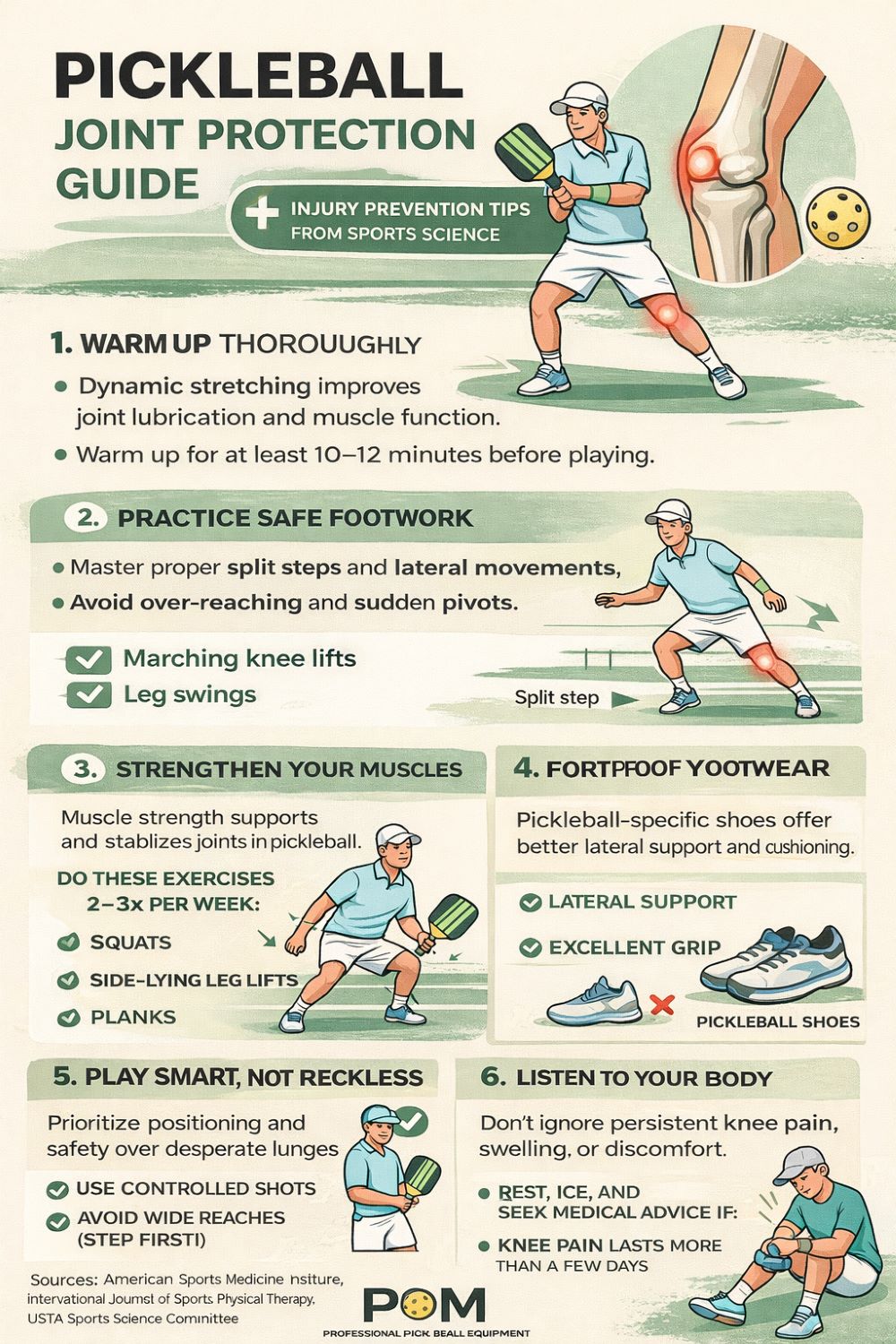
3. Warm-Up: The First Line of Joint Protection

One of the most common mistakes among recreational pickleball players is skipping a proper warm-up.

3.1 Why Warm-Up Reduces Injury Risk

A proper warm-up:

  • Increases joint lubrication (synovial fluid)

  • Improves muscle elasticity

  • Enhances neuromuscular coordination

  • Reduces stiffness in tendons and ligaments

Cold muscles and joints are far more prone to injury.

3.2 Recommended Pickleball-Specific Warm-Up (10–12 Minutes)

Dynamic Lower-Body Warm-Up

  • Marching knee lifts (1–2 minutes)

  • Side lunges with controlled depth

  • Hip circles and leg swings

  • Ankle rolls and calf raises

Upper-Body & Core Activation

  • Arm circles (small → large)

  • Torso rotations

  • Shoulder blade squeezes

  • Light paddle shadow swings

Sports science insight:
Dynamic warm-ups are far more effective than static stretching before play.

4. Footwork Technique: The Foundation of Knee Safety

4.1 The Importance of the Split Step

The split step is a small hop used before reacting to an opponent’s shot.

Correct split step:

  • Land on the balls of the feet

  • Knees slightly bent

  • Hips lowered

  • Weight evenly distributed

This position allows shock absorption through muscles instead of joints.

4.2 Avoiding Knee-Twisting Errors

Common dangerous habits:

  • Pivoting sharply on a planted foot

  • Reaching for wide balls instead of stepping

  • Lunging with locked knees

Correct approach:

  • Step first, then swing

  • Keep knees aligned with toes

  • Rotate through hips, not knees

5. Knee-Friendly Movement Patterns at the Kitchen Line

The non-volley zone (“kitchen”) is where most rallies occur—and where most knee stress accumulates.

5.1 Short Steps vs Big Lunges

Large lunges forward:

  • Increase compressive knee forces

  • Increase patellar tendon strain

Instead, use:

  • Short, controlled shuffle steps

  • Lower center of gravity

  • Balanced stance with core engagement

5.2 Recovery Footwork Matters

After each shot:

  • Recover to a neutral stance

  • Avoid over-reaching

  • Reset balance before the next shot

Good recovery reduces cumulative joint load.

6. Strength Training for Knee and Joint Protection

6.1 Why Muscle Strength Protects Joints

Strong muscles absorb impact and stabilize joints. Weak muscles force ligaments and cartilage to bear excessive load.

Key muscle groups for pickleball:

  • Quadriceps

  • Hamstrings

  • Glutes

  • Hip stabilizers

  • Core muscles

6.2 Essential Strength Exercises (2–3x per Week)

Lower-Body

  • Squats (bodyweight or light resistance)

  • Step-ups

  • Glute bridges

  • Hamstring curls

  • Calf raises

Hip & Core Stability

  • Side-lying leg raises

  • Resistance band walks

  • Planks

  • Anti-rotation core drills

Sports science note:
Hip weakness is strongly linked to knee pain. Strengthening hips significantly reduces knee injury risk.

7. Flexibility and Mobility: Protecting Long-Term Joint Health

7.1 Why Mobility Is as Important as Strength

Tight muscles change joint mechanics and increase stress on cartilage and ligaments.

Common tight areas in pickleball players:

  • Hip flexors

  • Hamstrings

  • Calves

  • Lower back

7.2 Post-Play Stretching Routine (10 Minutes)

  • Hamstring stretch

  • Quadriceps stretch

  • Calf stretch

  • Hip flexor stretch

  • Gentle spinal rotation

Stretch after play, not before, to improve recovery and maintain range of motion.

8. Footwear and Surface Interaction

8.1 Why Running Shoes Are a Mistake

Running shoes are designed for forward motion—not lateral stability.

Problems with running shoes:

  • Insufficient lateral support

  • Higher ankle roll risk

  • Increased knee torque

8.2 Proper Pickleball or Court Shoes

Look for:

  • Strong lateral stability

  • Low heel-to-toe drop

  • Good shock absorption

  • Non-slip outsole for indoor/outdoor courts

Footwear plays a direct role in knee injury prevention.

9. Equipment Design and Joint Stress

9.1 Paddle Weight and Balance

Heavier paddles:

  • Increase shoulder and elbow stress

  • Fatigue muscles faster

  • Reduce reaction efficiency

Balanced or slightly head-light paddles:

  • Improve control

  • Reduce joint strain

  • Allow smoother swing mechanics

9.2 Ball Speed and Rally Style

Faster balls lead to:

  • More explosive lunges

  • Higher deceleration forces

Training with appropriate balls for your level reduces unnecessary stress.

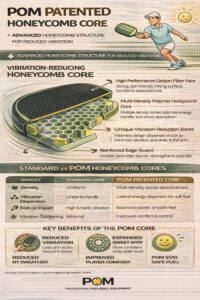
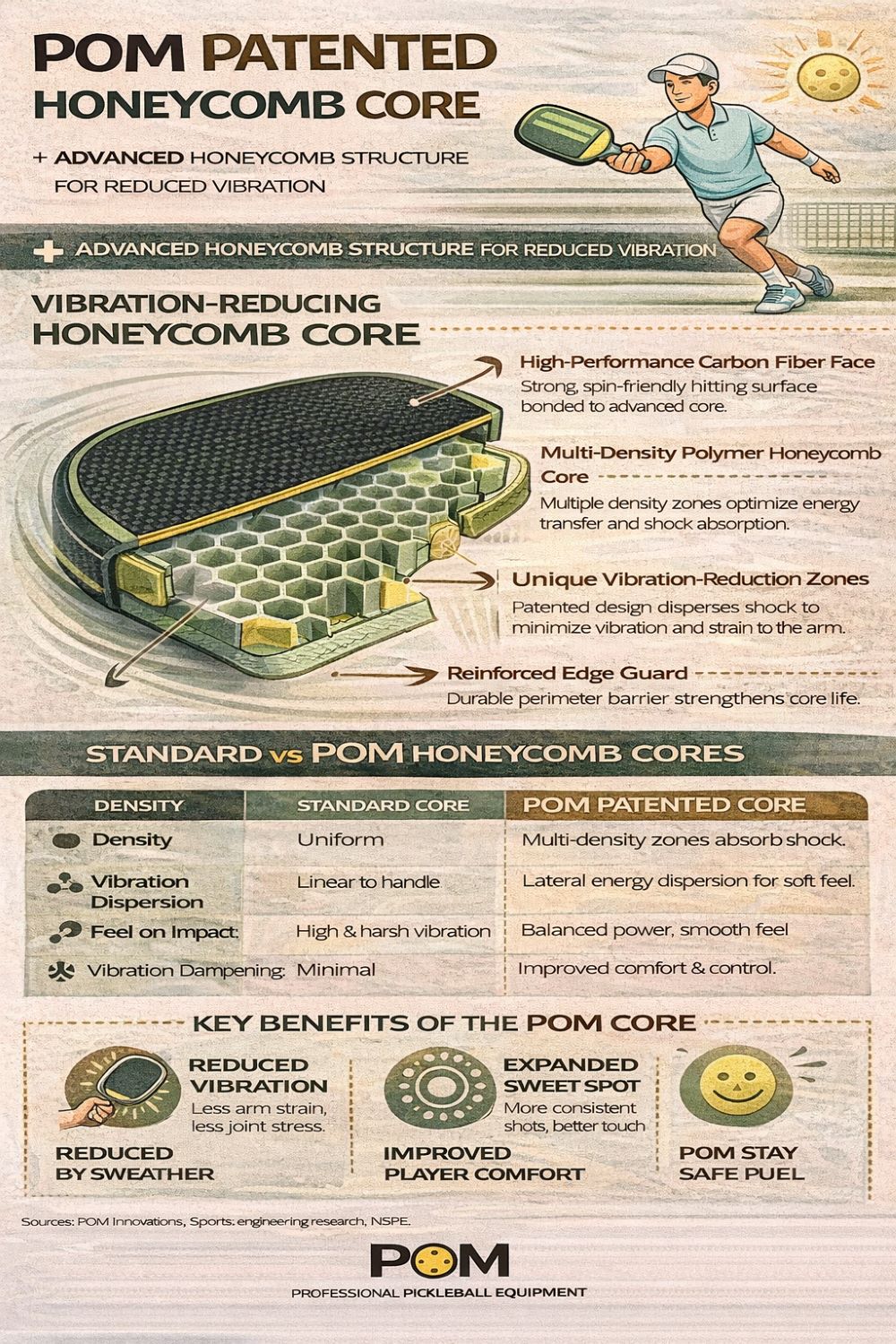
As a manufacturer, POM designs paddles and balls with controlled rebound and vibration damping to support joint health.

10. Overuse Injuries: The Hidden Risk

10.1 Why Overuse Happens in Pickleball

Pickleball’s fun and social nature often leads to:

  • Long sessions

  • Multiple matches per day

  • Insufficient recovery

Over time, repetitive micro-stress leads to tendon and cartilage damage.

10.2 Smart Load Management

  • Limit high-intensity sessions

  • Alternate hard play with light drills

  • Take rest days

  • Cross-train with swimming or cycling

Consistency matters more than volume.

11. Age-Specific Injury Prevention Considerations

11.1 Middle-Aged and Senior Players

Age-related changes include:

  • Reduced cartilage thickness

  • Slower muscle recovery

  • Decreased balance

Recommendations:

  • Longer warm-ups

  • Lower play intensity

  • Focus on doubles over singles

  • Use lighter paddles

11.2 Younger Competitive Players

Risks include:

  • Overtraining

  • Poor movement habits

  • Ignoring recovery

Structured strength and mobility training is essential for long-term health.

12. Signs You Should Not Ignore

Early warning signs:

  • Persistent knee soreness

  • Swelling after play

  • Joint stiffness lasting more than 48 hours

  • Sharp pain during lunges or stops

Ignoring these signs often leads to more serious injury.

Rule of thumb:
Pain is information, not weakness.

13. Injury Prevention Through Smart Playing Strategy

Strategic choices reduce injury risk:

  • Play higher-percentage shots

  • Avoid desperation lunges

  • Reset rallies instead of forcing winners

  • Position early instead of reacting late

Better strategy = less physical stress.

14. Recovery: The Missing Link in Joint Health

14.1 Importance of Recovery

Recovery allows:

  • Tissue repair

  • Inflammation reduction

  • Nervous system reset

14.2 Recovery Tools

  • Light stretching

  • Foam rolling

  • Adequate sleep

  • Hydration

  • Anti-inflammatory nutrition

Recovery is part of training, not an afterthought.

15. The Role of Equipment Manufacturers in Injury Prevention

As a professional manufacturer, POM integrates sports science into product development by focusing on:

  • Paddle vibration control

  • Balanced weight distribution

  • Durable, predictable ball bounce

  • Equipment suited for different age groups and intensities

Well-designed equipment reduces unnecessary joint stress, helping players stay healthy longer.

Play Longer, Play Safer

Pickleball offers tremendous health, social, and fitness benefits—but like any sport, it must be played with awareness of biomechanics and injury prevention.

By focusing on:

  • Proper warm-up

  • Correct footwork

  • Strength and mobility training

  • Appropriate footwear and equipment

  • Smart recovery habits

Players can dramatically reduce the risk of joint and knee injuries, allowing them to enjoy pickleball for years or even decades.

At POM, we believe the future of pickleball lies not only in performance—but in sustainable, injury-free participation. Our commitment to sports-science-driven design helps players, clubs, and partners worldwide build a healthier pickleball community.

contact POM

We have a pickleball paddles factory of skilled engineers ready to support you in your product development journey from idea design to production.Any ideas about your product you can contact us freely,and our engineers will get back to you with a quote asap. Whatsapp +86 18902611680

As a leading pickleball factory, POM is committed to providing high-quality sports equipment and accessories for pickleball enthusiasts. We believe that pickleball is not only a competitive sport, but also a lifestyle.

We pecialize in the design and production of high quality pickleball equipments,such as pickleball paddles,pickleball balls,pickleball nets,pickleball accessories…

With over a decade of expertise, POM stands as a leading manufacturer of premium pickleball sports equipment, operating from a 10,000-square-meter state-of-the-art facility. Specializing in the design, production, and customization of paddles, balls, nets, and accessories, we combine innovation with reliability to serve global brands, retailers, and sports enthusiasts.

•Of course, usually we will provide samples for your testing. For custom printed samples, pls send your requirements to us for checking the sample cost.
• It takes about 7 days for sample production.

Sure. We can do any packaging with your design. You can still have your own logo.

Picture of Leo-Pickleball expert
Leo-Pickleball expert

Foreign trade business director
13 years of business experience
Serve well-known brand customers
Any questions, please feel free to contact me immediately!

More to explorer

Receive the latest news

Quick reply