From Tennis to Pickleball: A Proven Path to Success for Transitioning Players

Table of Contents
Facebook
LinkedIn
Pinterest
X

Last Updated on 2026-01-19 by Pickleball Expert
Why More Tennis Players Are Switching to Pickleball

Across North America, Europe, and Asia-Pacific, one trend is unmistakable: a growing number of tennis players are transitioning to pickleball. What began as a recreational curiosity has evolved into a global movement, with former tennis athletes becoming some of the fastest-improving pickleball competitors.

At POM, as a professional manufacturer of pickleball paddles, balls, and equipment, we work closely with clubs, brands, and professional players worldwide. Through product development and direct interviews with athletes, we have identified a consistent pattern: players with a tennis background often achieve rapid success in pickleball—when they adapt correctly.

This article provides a complete roadmap for tennis players seeking to succeed in pickleball, combining:

  • Biomechanics and sports science

  • Player interview insights

  • Equipment transition guidance

  • Tactical and mental adjustments

This is not a beginner’s overview. It is a structured transition guide for serious tennis players who want to build a sustainable and competitive pickleball game.

1. Tennis and Pickleball: Similar Sports, Different Demands

1.1 Why Tennis Players Adapt Quickly to Pickleball

Tennis players possess several transferable skills:

  • Hand-eye coordination

  • Court awareness

  • Spin control

  • Footwork discipline

  • Competitive mindset

These attributes shorten the learning curve significantly.

However, pickleball is not “mini tennis.” The tactical and mechanical demands differ in key areas that require deliberate retraining.

1.2 Key Structural Differences Between Tennis and Pickleball

FactorTennisPickleball
Court sizeLargeCompact
Rally stylePower-basedControl-based
Net playOccasionalConstant
BallHigh bounceLow bounce
SwingLongCompact

Understanding these differences is the foundation of a successful transition.

2. The Biomechanical Shift: From Power to Precision

2.1 Why Full Tennis Swings Fail in Pickleball

Many former tennis players initially struggle because they overhit. Full swings that work in tennis often lead to:

  • Balls flying long

  • Loss of control in the kitchen

  • Increased unforced errors

Pickleball rewards:

  • Compact strokes

  • Soft hands

  • Controlled acceleration

2.2 The Pickleball Swing Model

Successful transitioning players adopt:

  • Shorter backswings

  • More wrist stability

  • Earlier contact points

  • Greater use of touch and placement

This biomechanical efficiency reduces fatigue and improves consistency.

3. The Kitchen Line: The Tactical Heart of Pickleball

3.1 Why the Non-Volley Zone Changes Everything

In tennis, net dominance is optional. In pickleball, kitchen control is mandatory.

Players who remain at the baseline will lose consistently to opponents who master the non-volley zone.

3.2 How Tennis Players Must Rethink Net Play

In tennis:

  • You attack the net to finish points

In pickleball:

  • You live at the net to control rallies

This requires patience rather than aggression.

4. The Soft Game Revolution: Dinking vs Driving

4.1 The Mental Barrier for Tennis Players

Tennis culture values winners. Pickleball culture values forcing errors.

Many former tennis players struggle with:

  • Slow-paced rallies

  • Extended dink exchanges

  • Strategic patience

Yet elite pickleball is decided in the soft game.

4.2 Why Dinking Wins Matches

Sports analytics shows that:

  • Most points at advanced levels are won by positional mistakes, not power shots

  • Players who dominate dink consistency control rally tempo

Mastering dinks transforms former tennis players into elite pickleball competitors.

5. Serve and Return: A Strategic Recalibration

5.1 The Pickleball Serve Is a Setup Shot

In tennis, the serve is a weapon.

In pickleball, the serve is a positioning tool.

Effective pickleball serves prioritize:

  • Depth

  • Placement

  • Consistency

Power is secondary.

5.2 The Importance of the Third Shot Drop

Former tennis players must learn the most important shot in pickleball:

The third shot drop.

This soft shot allows the serving team to advance to the kitchen safely.

Without mastering this shot, no player—regardless of tennis pedigree—can progress beyond intermediate level.

6. Footwork Evolution: Smaller Court, Faster Reactions

6.1 How Pickleball Footwork Differs

Pickleball footwork emphasizes:

  • Micro-adjustments

  • Lateral shuffles

  • Split-step timing

Large tennis strides are inefficient on a compact pickleball court.

6.2 Why Balance Beats Speed

Pickleball points are often decided in tight spaces. Players who maintain balance:

  • Reset more balls

  • Recover faster

  • Commit fewer net violations

7. Equipment Transition: Why Tennis Gear Does Not Translate Directly

7.1 Paddle Selection for Former Tennis Players

Many tennis players initially choose overly powerful paddles. This leads to control problems.

The optimal transition paddle should offer:

  • Medium power

  • High control

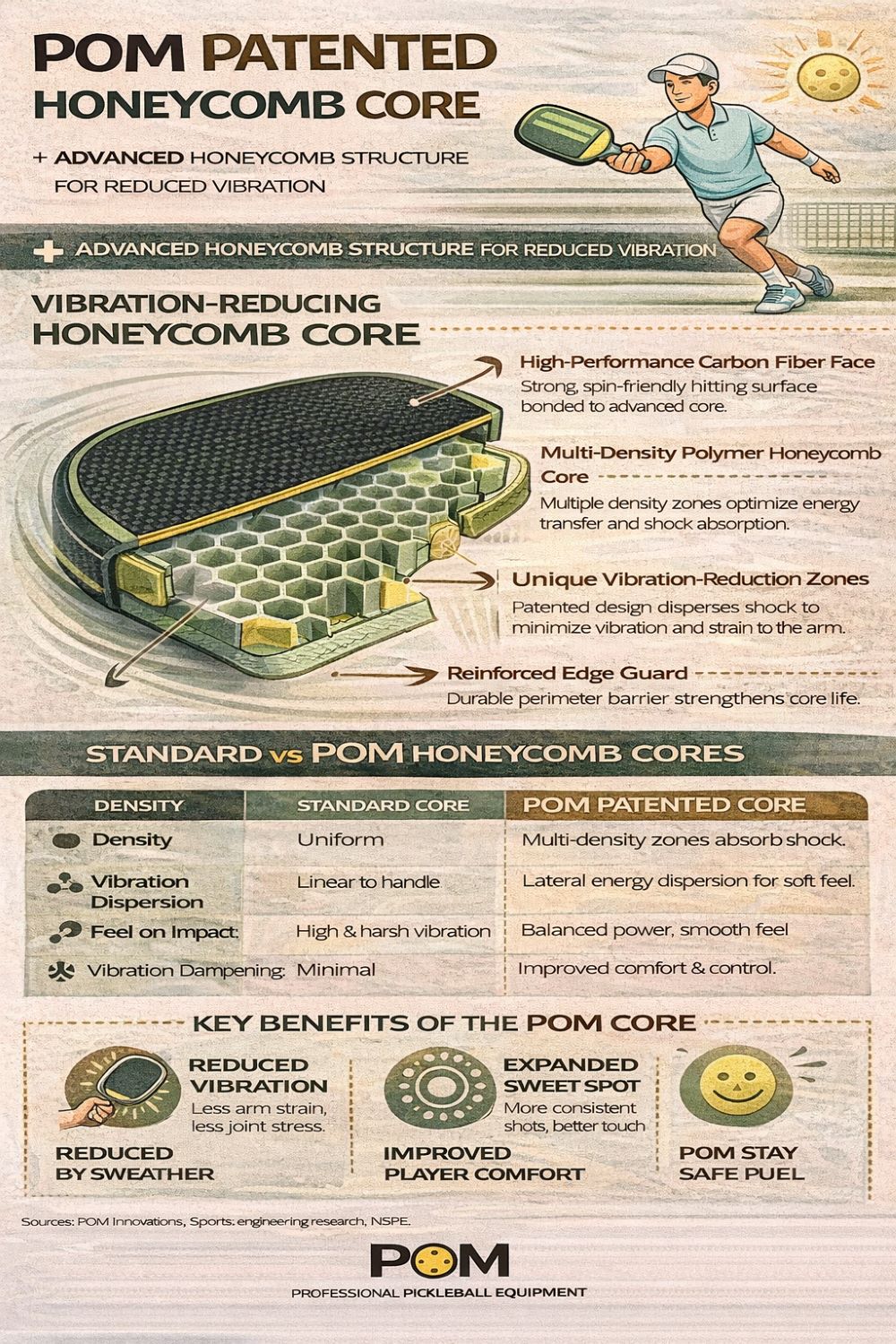
  • Vibration dampening

  • Balanced weight

At POM, we design paddles specifically for players migrating from tennis, focusing on touch stability and reduced shock load.

7.2 Ball Feel and Control Adjustment

Pickleball balls respond differently from tennis balls:

  • Lower bounce

  • Faster deceleration

  • Greater sensitivity to spin

Players must recalibrate timing and swing mechanics.

8. Net Reflexes: A Natural Advantage for Tennis Players

Former doubles tennis players possess strong reflex skills that translate well to:

  • Volleys

  • Blocks

  • Hands battles

However, pickleball volley technique favors:

  • Short punches

  • Soft resets

  • Paddle face control

Power volleys are rarely optimal.

9. Spin Adaptation: From Heavy Topspin to Controlled Rotation

9.1 Why Extreme Topspin Is Less Effective

Pickleball balls do not respond to spin like tennis balls. Excessive topspin:

  • Reduces margin for error

  • Causes misjudged bounces

Effective pickleball spin is subtle and strategic.

9.2 The Rise of the Roll Volley and Slice Dink

Former tennis players excel when they learn:

  • Controlled topspin roll volleys

  • Backspin dinks for kitchen pressure

10. Tactical Intelligence: Why Tennis IQ Transfers Well

Tennis players possess advanced match awareness:

  • Shot selection

  • Opponent tendencies

  • Court geometry

When properly adapted, this strategic intelligence accelerates pickleball mastery.

The key is applying it to:

  • Kitchen positioning

  • Shot patience

  • Rally construction

11. Injury Risk During Transition: What Tennis Players Must Watch

11.1 Overuse Injuries from Improper Adaptation

Common transition injuries include:

  • Elbow tendinitis from gripping too tightly

  • Knee strain from excessive lunging

  • Achilles stress from improper footwear

Proper technique and equipment selection reduce risk.

12. Case Insights from POM Player Interviews

Through interviews with dozens of former tennis players, we observe three consistent success factors:

  1. Early commitment to the soft game

  2. Willingness to abandon full tennis swings

  3. Investment in appropriate pickleball equipment

Those who adopt these principles reach competitive levels in half the time.

13. The Psychological Shift: Redefining Winning

Tennis rewards aggression. Pickleball rewards discipline.

Former tennis players succeed when they accept that:

  • Forcing errors is more powerful than hitting winners

  • Consistency beats brilliance

  • Control wins championships

This mindset shift is often the final barrier to elite performance.

14. Why Tennis Players Are Shaping the Future of Pickleball

Former tennis athletes are now:

  • Leading professional tours

  • Coaching at elite academies

  • Driving tactical evolution

Their influence is raising the technical ceiling of modern pickleball.

15. How POM Supports Transitioning Tennis Players

As a professional pickleball equipment manufacturer, POM focuses on:

  • Paddle designs optimized for control and stability

  • Ball specifications for competitive consistency

  • Custom equipment solutions for clubs and brands

Our product development is informed directly by former tennis players adapting to pickleball.

A Proven Roadmap from Tennis to Pickleball Excellence

The transition from tennis to pickleball is not a downgrade—it is an evolution.

Former tennis players possess a powerful foundation, but success depends on adaptation:

  • Biomechanical efficiency

  • Tactical patience

  • Equipment optimization

  • Mental recalibration

Those who embrace these changes often become the fastest-rising players in the sport.

At POM, we have witnessed this transformation firsthand across global markets. With the right approach, the journey from tennis to pickleball is not only achievable—it is a proven path to competitive excellence.

contact POM

We have a pickleball paddles factory of skilled engineers ready to support you in your product development journey from idea design to production.Any ideas about your product you can contact us freely,and our engineers will get back to you with a quote asap. Whatsapp +86 18902611680

As a leading pickleball factory, POM is committed to providing high-quality sports equipment and accessories for pickleball enthusiasts. We believe that pickleball is not only a competitive sport, but also a lifestyle.

We pecialize in the design and production of high quality pickleball equipments,such as pickleball paddles,pickleball balls,pickleball nets,pickleball accessories…

With over a decade of expertise, POM stands as a leading manufacturer of premium pickleball sports equipment, operating from a 10,000-square-meter state-of-the-art facility. Specializing in the design, production, and customization of paddles, balls, nets, and accessories, we combine innovation with reliability to serve global brands, retailers, and sports enthusiasts.

•Of course, usually we will provide samples for your testing. For custom printed samples, pls send your requirements to us for checking the sample cost.
• It takes about 7 days for sample production.

Sure. We can do any packaging with your design. You can still have your own logo.

Picture of Leo-Pickleball expert
Leo-Pickleball expert

Foreign trade business director
13 years of business experience
Serve well-known brand customers
Any questions, please feel free to contact me immediately!

More to explorer

Receive the latest news

Quick reply