

The global pickleball market continues to attract sports brands, distributors, retailers, clubs, and entrepreneurs looking to develop their own products. As competition increases, many companies are moving beyond generic products and investing in their own branded equipment.
An OEM pickleball paddle is one of the most effective ways for a brand to create a differentiated product without building its own manufacturing facility.
OEM stands for Original Equipment Manufacturer. In the pickleball industry, an OEM project generally means that a brand works with a professional manufacturer to develop and produce pickleball paddles according to specific requirements. Depending on the project, customization can include paddle shape, dimensions, thickness, core, face material, surface texture, weight, balance, handle, grip, graphics, logo, packaging, and other specifications.
However, successful OEM production involves much more than putting a brand logo on an existing paddle.
The performance of an OEM pickleball paddle depends on the relationship between materials, geometry, manufacturing processes, quality control, and product specifications.
For this reason, choosing the right pickleball paddle manufacturer is one of the most important decisions a brand needs to make.
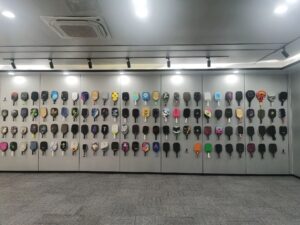
POM is a professional pickleball equipment manufacturer specializing in pickleball paddles, pickleballs, portable pickleball nets, and related equipment. With a 6,000-square-meter manufacturing facility, POM provides OEM and ODM solutions for brands looking to develop customized pickleball products.
This guide explains the major considerations involved in developing an OEM pickleball paddle and how POM can help brands move from an initial concept to reliable mass production.
1. What Is an OEM Pickleball Paddle?
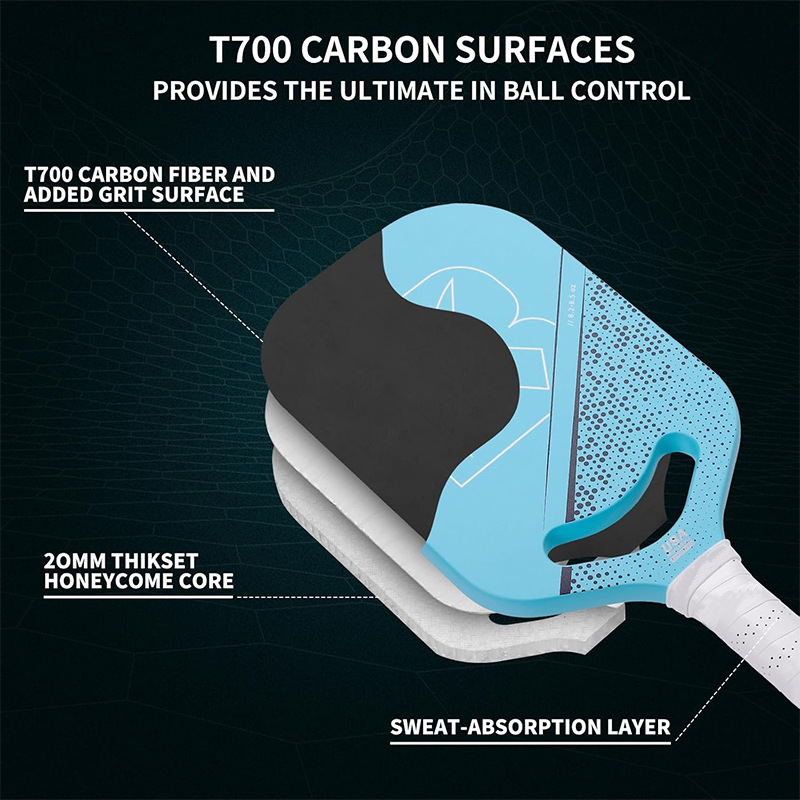
An OEM pickleball paddle is a paddle manufactured according to a customer’s brand, design, technical specifications, or product requirements.
Instead of purchasing a standard paddle from a catalog, the brand works with an OEM manufacturer to create a product that represents its own market positioning.
An OEM pickleball paddle project may include customization of:
- Paddle shape
- Paddle size
- Paddle thickness
- Core material
- Face material
- Surface texture
- Weight
- Balance
- Handle length
- Grip circumference
- Grip material
- Edge construction
- Logo
- Colors
- Packaging
There are different levels of OEM customization.
Basic OEM
The manufacturer provides an existing paddle platform, while the customer customizes:
- Logo
- Graphics
- Colors
- Grip
- Packaging
Semi-Custom OEM
The customer modifies selected technical specifications, such as:
- Shape
- Thickness
- Core
- Face material
- Handle
- Weight
Fully Customized OEM
The customer develops a substantially new product with the manufacturer.
This can involve:
- New CAD design
- Custom mold
- New material structure
- Prototype development
- Performance optimization
- Custom branding
- Custom packaging
The more customization required, the more important the manufacturer’s engineering capabilities become.
2. OEM Pickleball Paddle Design Starts with Product Positioning
Before choosing materials, a brand should define the target player.
An OEM pickleball paddle designed for beginners may prioritize:
- Forgiveness
- Stability
- Comfortable handling
- Durability
- Competitive pricing
An advanced paddle may prioritize:
- Spin
- Power
- Control
- Fast handling
- Precise feedback
A premium performance paddle may require a more sophisticated combination of materials and manufacturing technologies.
Therefore, POM recommends beginning OEM development with a simple question:
Who is the paddle designed for?
A useful development sequence is:
Target customer → Playing style → Performance objective → Paddle structure → Material selection → Prototype → Testing → Mass production
This approach prevents brands from selecting materials simply because they are popular in the market.
The best material is the material that supports the intended product performance and price positioning.
3. OEM Pickleball Paddle Shape and Geometry
Paddle geometry has a direct influence on how a paddle feels during play.
When developing an OEM pickleball paddle, brands can consider:
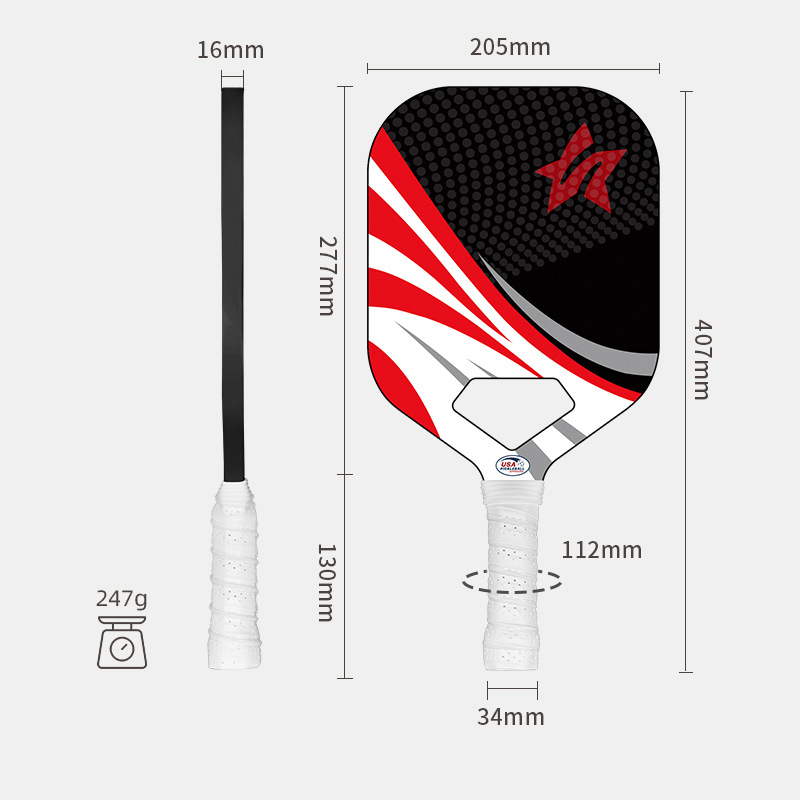
- Overall paddle length
- Paddle width
- Head shape
- Edge profile
- Handle length
- Grip circumference
- Sweet-spot location
A wider paddle can provide a different combination of stability and hitting area compared with an elongated paddle.
An elongated paddle can provide additional reach and a different balance of power and maneuverability.
There is no single paddle shape that is ideal for every player.
A professional custom pickleball paddle manufacturer should therefore help the customer connect geometry with the intended playing characteristics.
For completely new shapes, a custom mold may be necessary.
This is one reason brands should evaluate a manufacturer’s engineering and tooling capabilities before starting an OEM project.
4. OEM Pickleball Paddle Core Selection
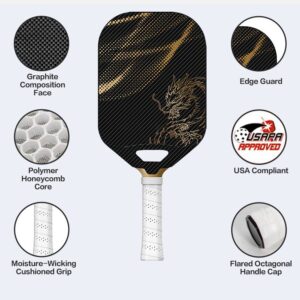
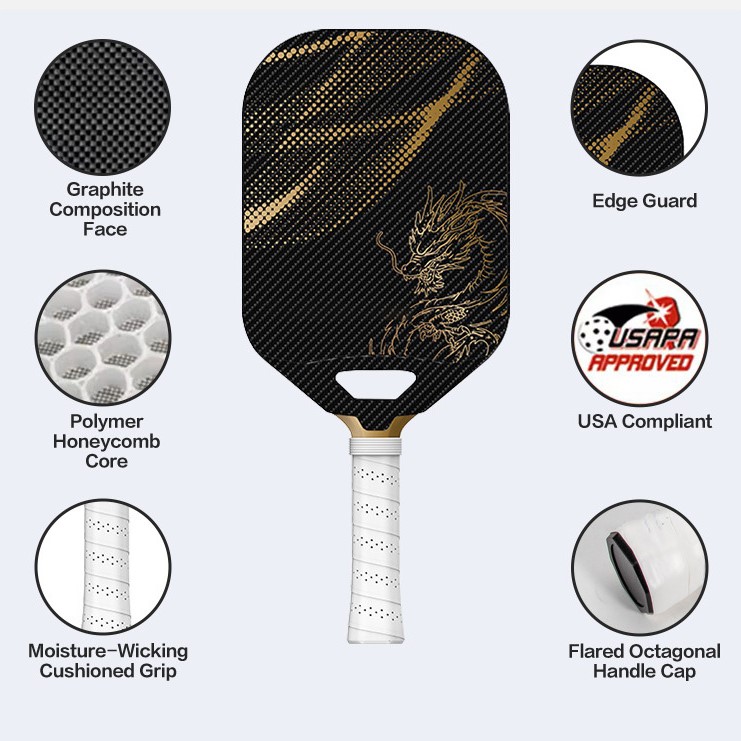
The core is one of the most important internal components of an OEM pickleball paddle.
Modern paddles commonly use honeycomb core structures, with polymer-based cores being particularly common.
Core design can influence:
- Power
- Control
- Stability
- Vibration
- Feel
- Weight
- Acoustic response
Important core variables include:
- Core thickness
- Cell structure
- Material properties
- Density
- Compression
- Manufacturing tolerance
A brand looking for a control-oriented paddle may require a different construction from a brand developing a power-oriented paddle.
The core also needs to work together with the face material.
For example:
Face + Core + Thickness + Bonding + Geometry = Paddle Response
Therefore, an experienced pickleball paddle factory should evaluate the entire paddle structure instead of recommending a core material in isolation.
POM can help brands compare different core configurations according to their target performance.
5. OEM Pickleball Paddle Face Materials
The face is another critical component.
Common materials used in modern paddle construction include:
- Carbon fiber
- Fiberglass
- Hybrid composite materials
Carbon fiber has become particularly popular in performance-oriented paddles because of its lightweight characteristics, stiffness, and suitability for advanced composite structures.
Fiberglass can provide a different mechanical response and may be appropriate for particular recreational or performance products.
However, “carbon fiber” alone does not define a paddle’s performance.
Different carbon fiber constructions can vary in:
- Fiber type
- Weave
- Thickness
- Layup
- Resin
- Surface treatment
- Bonding process
When developing an OEM pickleball paddle, brands should therefore request specific material specifications rather than relying on general marketing terminology.
POM works with customers to select face materials according to:
Performance + Durability + Cost + Manufacturing Requirements
6. OEM Pickleball Paddle Thickness
Paddle thickness affects structural behavior, stability, weight distribution, and player feel.
Different paddle thickness configurations can be developed for different performance objectives.
Brands may be looking for:
- Maximum control
- More power
- Greater stability
- Comfortable impact response
- Reduced vibration
- Balanced all-around performance
Thickness should never be evaluated independently.
A paddle’s final performance results from the interaction between:
Core + Face + Thickness + Geometry + Weight + Balance + Manufacturing Process
Therefore, simply making a paddle thicker does not automatically make it better.
An experienced OEM pickleball paddle manufacturer can help determine an appropriate construction based on the customer’s product objectives.
7. OEM Pickleball Paddle Weight and Balance
Two paddles with identical dimensions can feel completely different if their weight distribution is different.
For an OEM pickleball paddle, manufacturers and brands should consider:
- Static weight
- Balance point
- Swing weight
- Head weight
- Handle weight
- Perimeter weight distribution
A head-heavy paddle may generate a strong, powerful feel but can require more effort to maneuver.
A more handle-oriented paddle may feel faster during quick exchanges.
The correct balance depends on the target player.
Weight consistency is equally important.
If paddles within the same production batch have large weight variations, customers may experience noticeably different handling characteristics.
This is why POM pays attention not only to the nominal paddle weight but also to production consistency.
For commercial OEM projects, brands should define acceptable weight tolerances before mass production begins.
8. OEM Pickleball Paddle Surface Technology and Spin
Spin is an important performance characteristic for many modern pickleball paddles.
The paddle surface can affect:
- Ball engagement
- Friction
- Spin potential
- Ball feel
- Surface durability
An OEM paddle may use different surface constructions depending on the product objective.
Possible considerations include:
- Face material
- Surface texture
- Coating
- Finishing process
- Texture consistency
- Durability
However, a brand should not simply ask a factory for “maximum spin.”
The better approach is to define measurable technical objectives and confirm that the final product is suitable for the intended market and applicable competition requirements.
For paddles intended for sanctioned competition, brands should verify the latest applicable equipment rules and approval requirements before commercial production.
9. OEM Pickleball Paddle Handle and Grip
The handle is one of the most important interfaces between the player and the paddle.
An excellent face and core cannot compensate for an uncomfortable grip.
An OEM pickleball paddle can be customized through:
- Handle length
- Handle shape
- Grip circumference
- Grip material
- Grip thickness
- Grip texture
- Cushioning
- Sweat absorption
Grip tape also needs to be applied consistently.
Poor adhesive selection or incorrect wrapping can cause:
- Peeling
- Movement
- Wrinkles
- Reduced traction
- Premature wear
For brands, the grip can also contribute to product identity.
POM can help customers customize grip colors, materials, branding, and specifications according to the product design.
10. OEM Pickleball Paddle Edge Construction
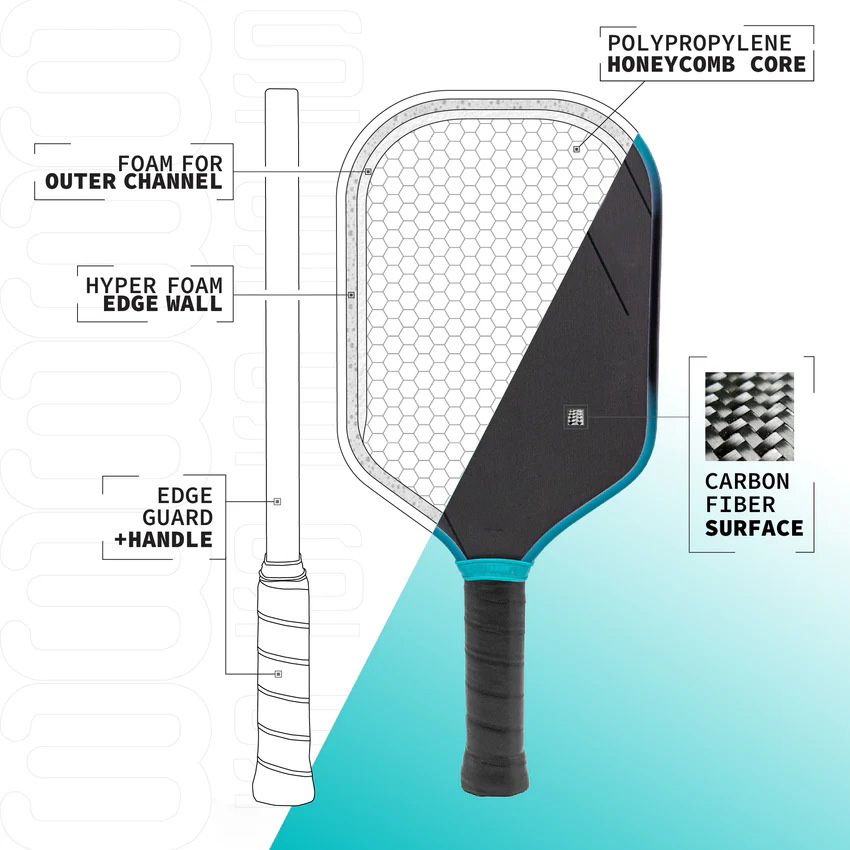
The paddle edge protects the structure and contributes to overall durability.
OEM designs can use different edge solutions, including:
- Traditional edge guards
- Integrated edge structures
- Foam-enhanced perimeter designs
- Reinforced edge constructions
Edge construction influences more than appearance.
It can affect:
- Weight distribution
- Balance
- Durability
- Impact resistance
- Structural integrity
For example, adding excessive material around the perimeter can change the paddle’s balance and swing characteristics.
An OEM manufacturer therefore needs to consider the edge as part of the complete engineering system.
POM evaluates edge construction together with the core, face, mold, and overall paddle structure.
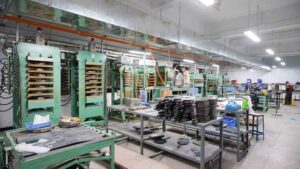
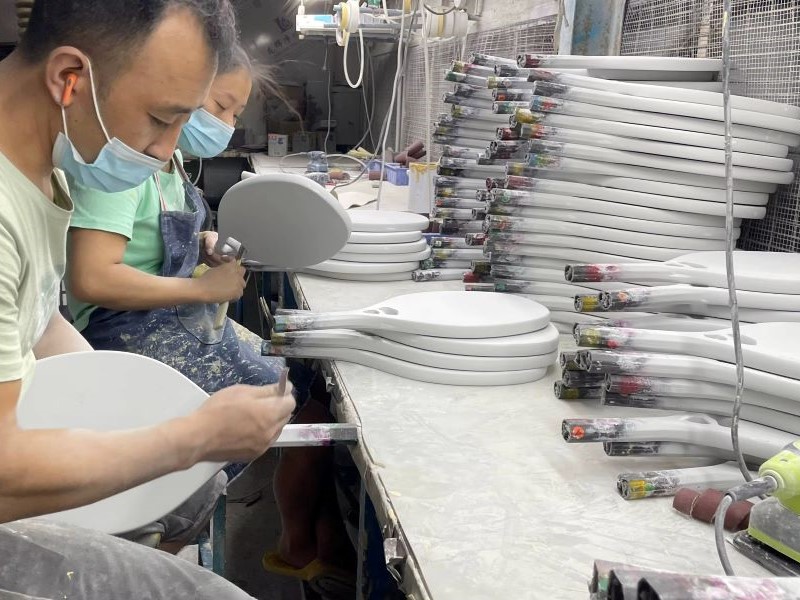
11. OEM Pickleball Paddle Manufacturing Process
The manufacturing process is where a product design becomes a physical paddle.
Depending on the design, an OEM pickleball paddle may involve:
- Raw material preparation
- Material cutting
- Face preparation
- Core preparation
- Lamination
- Pressing
- Thermoforming where applicable
- Bonding
- Edge construction
- Handle assembly
- Surface finishing
- Logo printing
- Grip installation
- Final inspection
- Packaging
Process parameters need to be controlled carefully.
For advanced paddle construction, important variables can include:
- Temperature
- Pressure
- Time
- Cooling
- Material positioning
- Adhesive application
- Core compression
Poor control can contribute to:
- Warping
- Delamination
- Weight variation
- Structural inconsistency
- Excessive vibration
A professional pickleball paddle factory should have clearly defined production procedures for every stage.
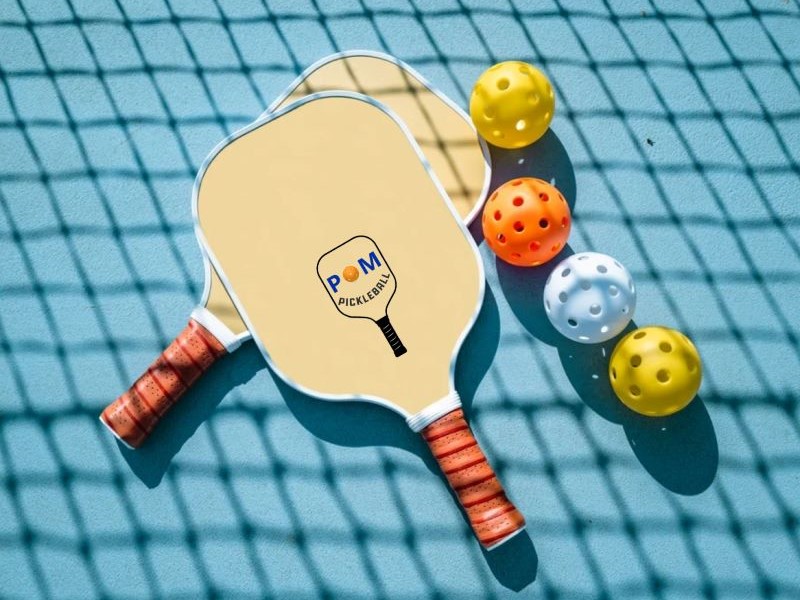
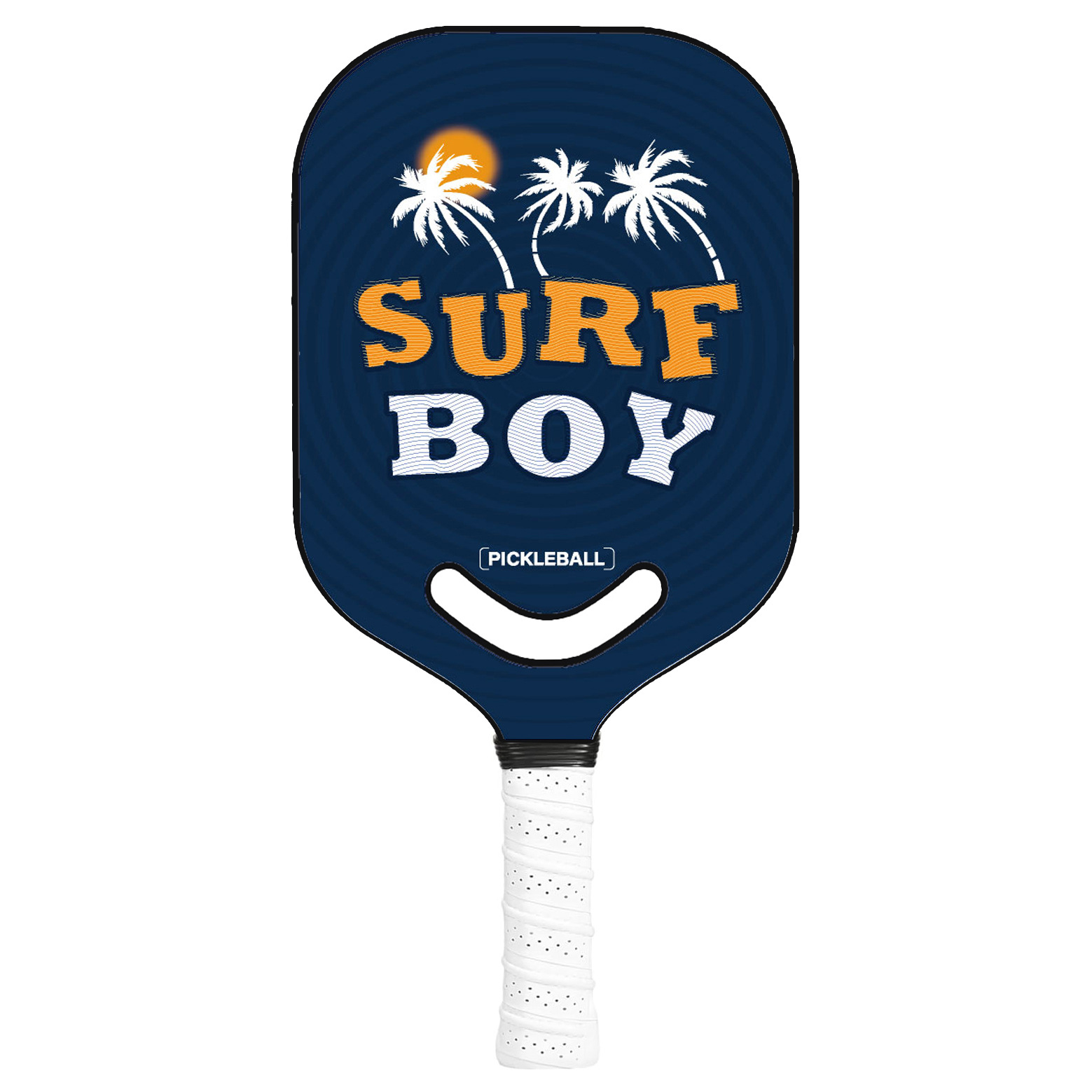
12. OEM Pickleball Paddle Logo and Branding
OEM production allows brands to build their own visual identity.
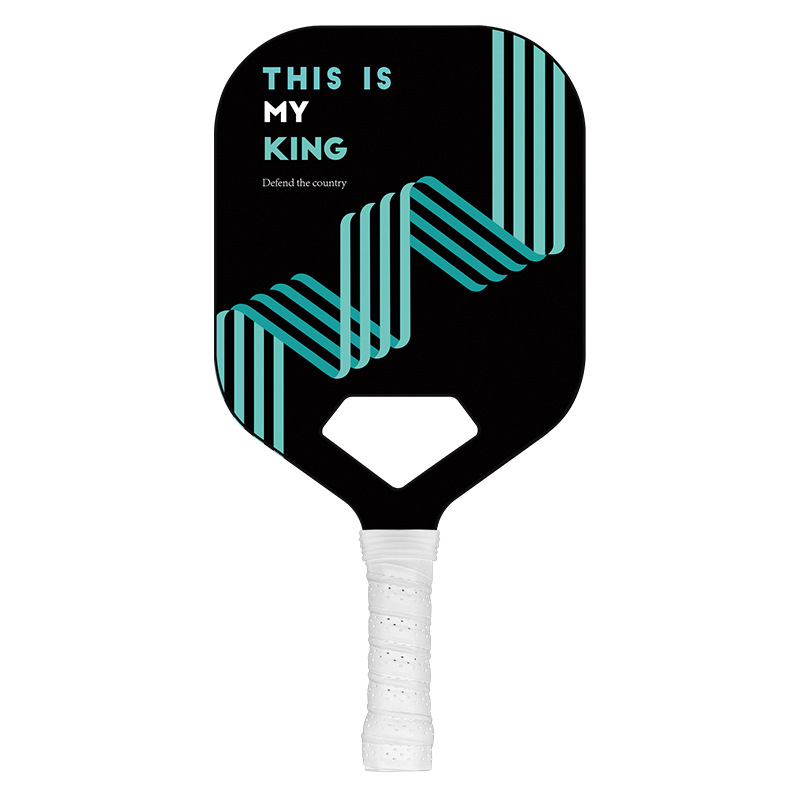
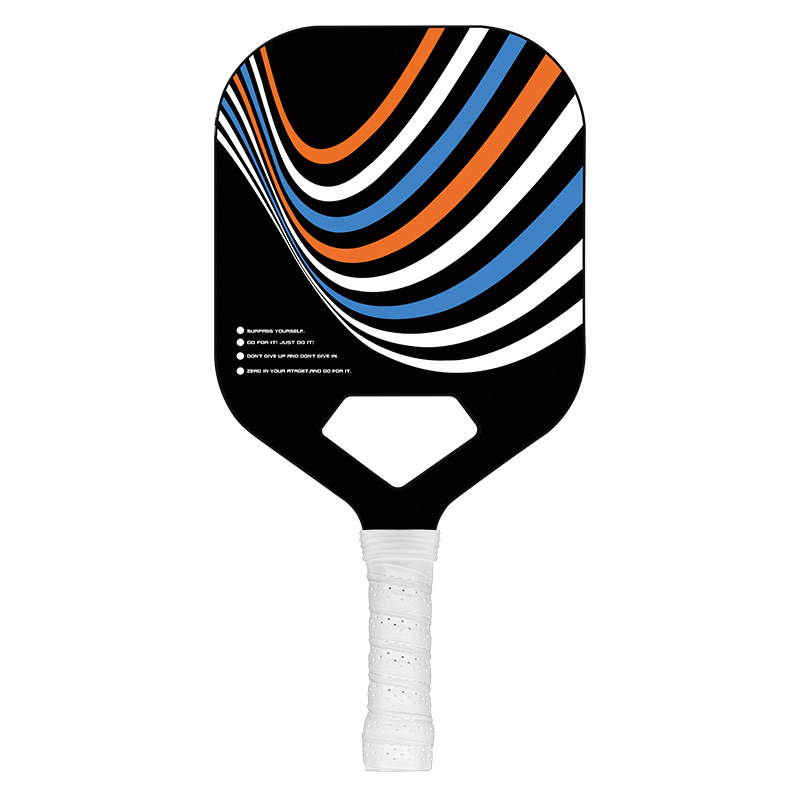
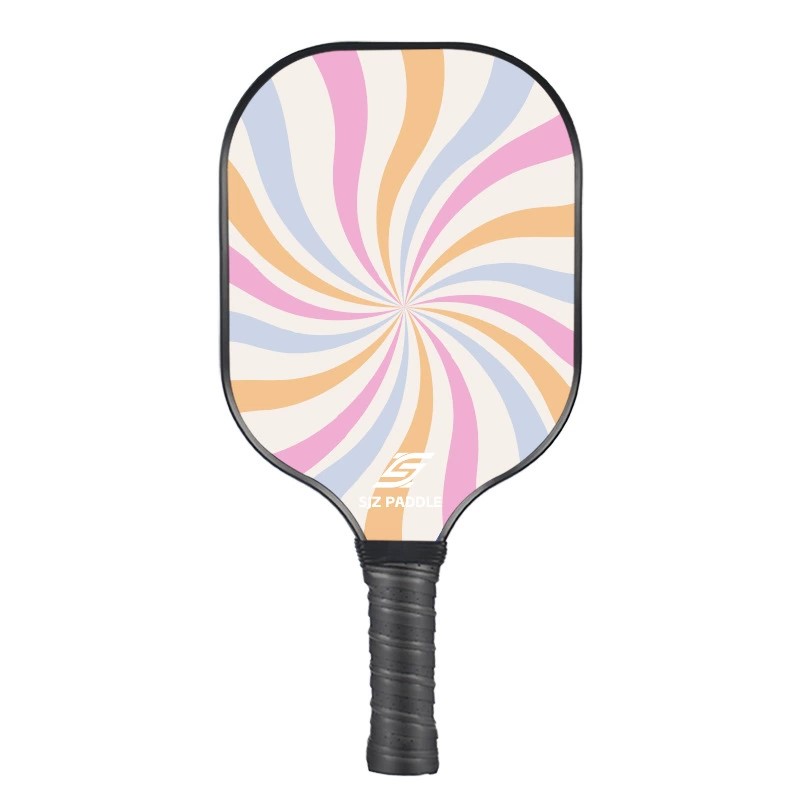
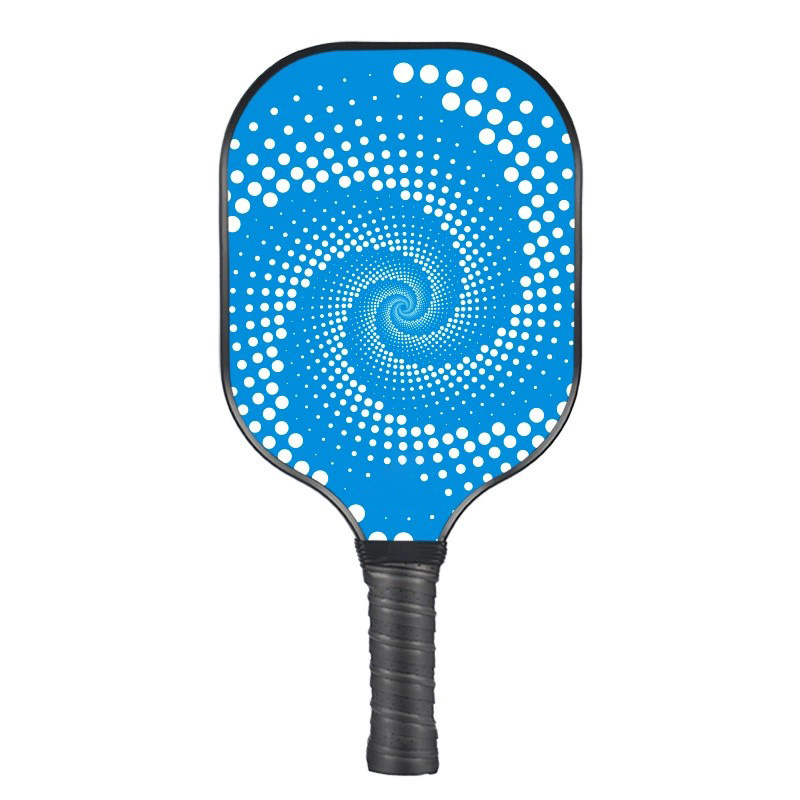
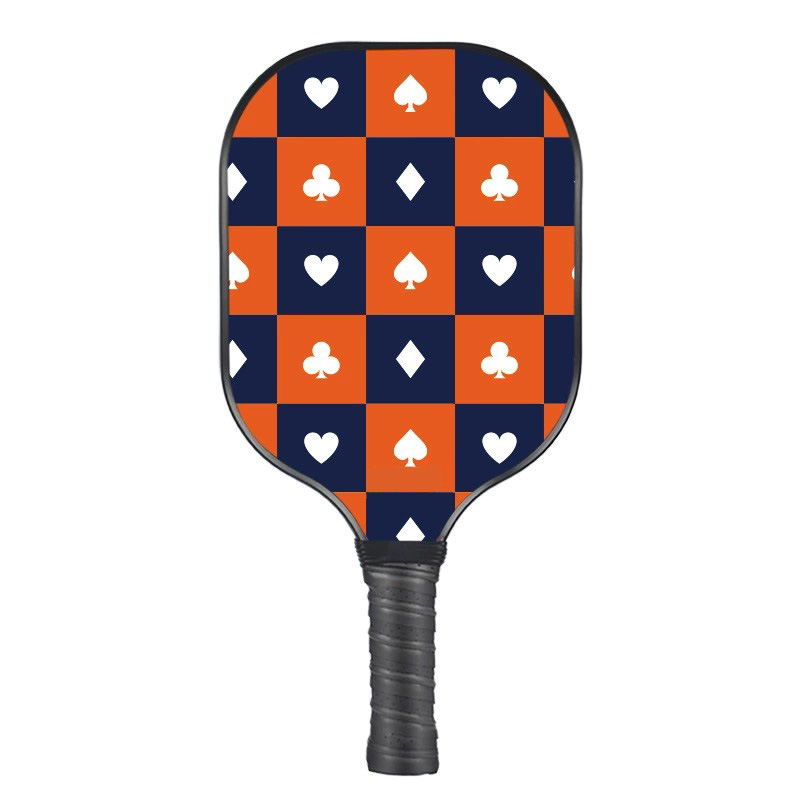
POM can support customization of:
- Brand logo
- Paddle graphics
- Colors
- Text
- Grip branding
- Packaging
Common printing methods can include:
- UV printing
- Silk-screen printing
- Other suitable printing technologies
The correct printing method depends on the paddle surface, artwork, production quantity, durability requirements, and desired visual effect.
Logo placement should also be standardized.
A professional manufacturer should work from approved artwork and production specifications to minimize variation between units.
For brands, this is especially important because consistent branding contributes directly to perceived product quality.
13. OEM Pickleball Paddle Prototype Development
A prototype is essential when developing a new OEM paddle.
A drawing may look perfect on a computer but feel different in a player’s hand.
Prototype evaluation can identify:
- Weight problems
- Balance issues
- Handle discomfort
- Surface problems
- Vibration
- Structural concerns
- Visual defects
The development process may follow:
Concept → CAD → Mold → Prototype → Testing → Modification → Final Sample → Mass Production
Some projects require multiple prototype rounds.
This is normal for highly customized products.
A good custom pickleball paddle manufacturer should treat prototype development as an engineering stage rather than simply producing a sample for visual approval.
POM works with customers to refine product specifications before mass production.
14. OEM Pickleball Paddle Quality Control
Quality control is one of the most important aspects of OEM manufacturing.
A brand may approve a perfect sample, but the real challenge is producing hundreds or thousands of paddles with the same specifications.
Quality management can include:
Incoming Material Inspection
Checking raw materials before production.
Process Inspection
Monitoring critical production parameters.
Finished Product Inspection
Checking:
- Weight
- Dimensions
- Appearance
- Balance
- Surface
- Edge
- Handle
- Grip
- Logo
- Packaging
The objective is to maintain production consistency.
For an OEM pickleball paddle, consistency is particularly important because players can notice differences in handling and feel.
POM uses standardized production procedures and quality-management practices to help maintain product consistency between batches.
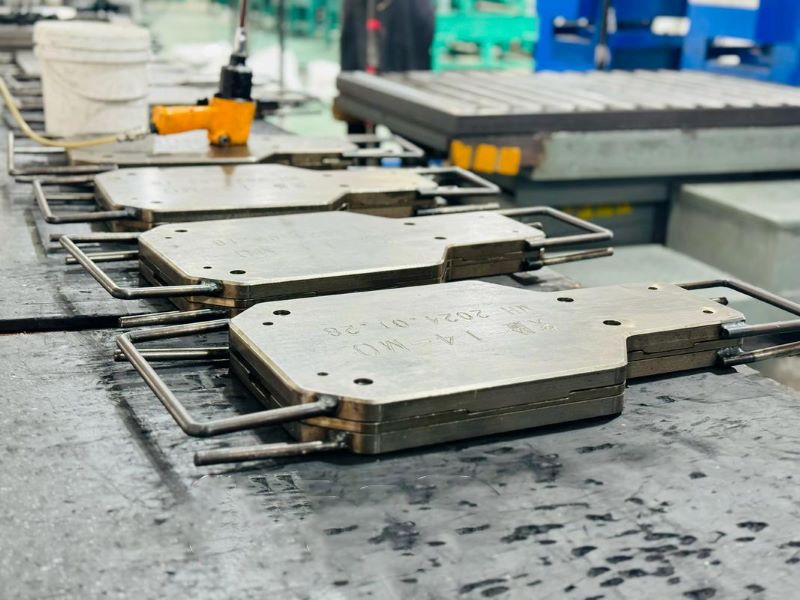
15. OEM Pickleball Paddle Mold Development
A unique paddle shape often requires a custom mold.
Mold development can influence:
- Initial tooling investment
- Product geometry
- Production efficiency
- Dimensional consistency
- Long-term production cost
Before approving a mold, brands should clarify:
- Mold design
- Mold material
- Tooling cost
- Expected lifespan
- Maintenance
- Modification policy
- Ownership
- Replacement terms
The cheapest mold quotation is not always the lowest total cost.
A poorly designed mold can create production problems later.
An experienced pickleball paddle manufacturer should therefore explain what is included in the tooling quotation.
16. OEM Pickleball Paddle MOQ and Production Planning
Minimum order quantity varies depending on:
- Paddle design
- Materials
- Customization level
- Mold requirements
- Printing
- Packaging
- Production process
A startup may prefer a smaller initial order to test the market.
An established brand may require larger volumes.
The important point is that MOQ should not determine quality.
A professional factory should use the same quality principles regardless of whether a customer is developing a small pilot order or a larger commercial production program.
POM works with brands to evaluate practical production quantities based on the actual project.
17. OEM Pickleball Paddle Testing and Compliance
Brands selling pickleball paddles internationally need to understand the requirements of their target market.
For competition-oriented products, applicable paddle rules may cover areas such as:
- Dimensions
- Surface characteristics
- Materials
- Construction
- Branding
- Other equipment specifications
If a paddle is intended for sanctioned competitions, the brand should verify current requirements with the relevant governing organization.
A manufacturer can help prepare samples and technical information, but the brand should confirm that the final product is suitable for its intended market.
This is particularly important when developing an OEM pickleball paddle for competitive players.
18. OEM Pickleball Paddle Packaging
Packaging should be considered part of the OEM product.
POM can provide customized:
- Paddle boxes
- Retail packaging
- Product inserts
- Instruction materials
- Labels
- Shipping cartons
Packaging can be designed according to the sales channel.
E-commerce Brands
Prioritize protection, compact dimensions, and shipping efficiency.
Retail Brands
Prioritize visual presentation and product information.
Premium Brands
Focus on materials, graphics, unboxing experience, and brand identity.
A complete pickleball equipment manufacturer should be able to coordinate paddle production and packaging rather than treating them as completely separate processes.

19. How to Choose an OEM Pickleball Paddle Manufacturer
Choosing an OEM supplier should not be based on unit price alone.
Brands should evaluate at least eight areas:
1. Factory Capability
Does the company operate a real manufacturing facility?
2. Engineering Capability
Can it develop new paddle structures?
3. Material Expertise
Can it explain core, face, adhesive, grip, and supporting materials?
4. Tooling Capability
Can it develop and maintain custom molds?
5. Production Technology
Can it handle the manufacturing process required by the product?
6. Quality Control
Does it have defined inspection procedures?
7. Customization
Can it customize the paddle rather than simply print a logo?
8. Scalability
Can it support the brand as order volume increases?
9. Communication
Can engineers and sales teams communicate clearly about technical specifications?
10. Product Range
Can the supplier support future products such as pickleballs and portable nets?
These factors provide a much more meaningful evaluation than comparing factory quotations alone.
20. Why POM Is a Preferred OEM Pickleball Paddle Manufacturer
POM is a professional pickleball paddle manufacturer and pickleball equipment manufacturer focused on the development and production of pickleball products.
Our product range includes:
- Pickleball paddles
- Pickleballs
- Portable pickleball nets
- Pickleball sets
- Related equipment
POM operates a 6,000-square-meter manufacturing facility with dedicated production equipment and established manufacturing procedures.
Our OEM/ODM services allow brands to develop products according to their market requirements.
Customization can include:
Paddle Design
- Shape
- Size
- Thickness
- Handle
Internal Construction
- Core
- Structural configuration
- Supporting materials
Face
- Carbon fiber
- Fiberglass
- Hybrid materials
- Surface treatment
Performance
- Weight
- Balance
- Control
- Power
- Spin
Branding
- Logo
- Colors
- Graphics
- Grip
- Packaging
This integrated approach allows POM to support brands from initial concept through commercial production.
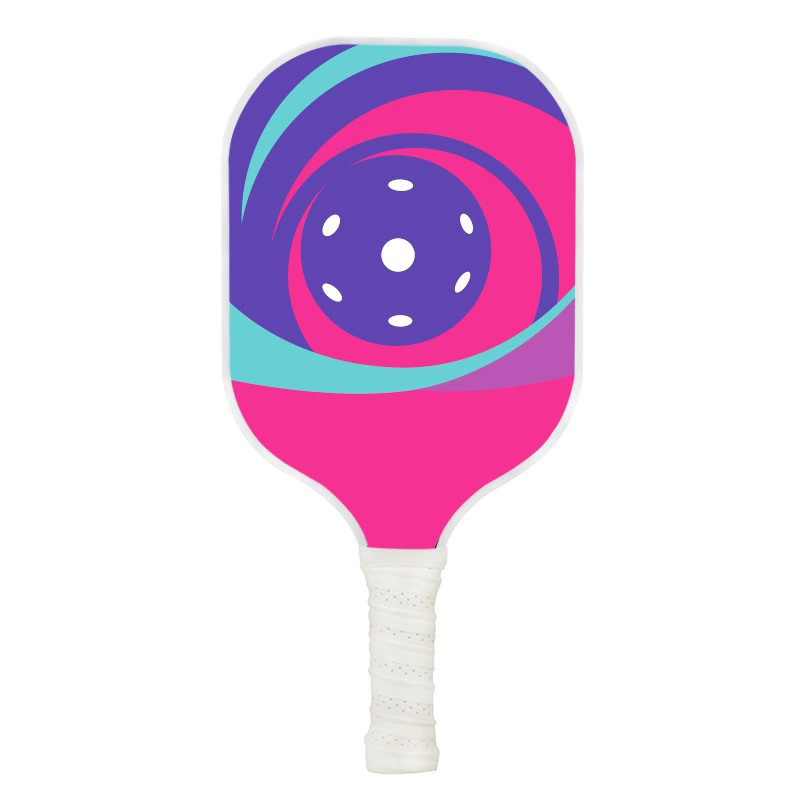
21. From Concept to Mass Production: POM's OEM Pickleball Paddle Workflow
A professional OEM project can be organized into several stages.
Stage 1: Product Brief
The brand provides target market, player profile, desired performance, and price positioning.
Stage 2: Technical Evaluation
POM evaluates materials, structure, manufacturing process, and potential tooling requirements.
Stage 3: Product Design
The paddle structure and specifications are developed.
Stage 4: Mold Development
A custom mold is developed when required.
Stage 5: Prototype
Samples are produced for evaluation.
Stage 6: Testing
The brand and manufacturer review:
- Weight
- Balance
- Feel
- Surface
- Grip
- Appearance
- Structural performance
Stage 7: Optimization
Necessary changes are made before final approval.
Stage 8: Mass Production
Production begins according to the approved specification.
Stage 9: Quality Inspection
Finished paddles are inspected according to agreed quality standards.
Stage 10: Packaging and Shipment
Products are packed according to the brand’s requirements.
This structured process reduces unnecessary communication problems and helps convert a product concept into a repeatable manufacturing specification.
OEM Pickleball Paddle FAQ
What is an OEM pickleball paddle?
An OEM pickleball paddle is a paddle produced by a manufacturer according to a customer’s brand, design, technical requirements, or product specifications.
Can I customize the shape of an OEM pickleball paddle?
Yes. Depending on the project, brands can customize paddle geometry. A completely new shape may require custom tooling.
Can I customize the core?
Yes. Core structure and specifications can be developed according to the desired performance and manufacturing requirements.
Can I use carbon fiber for an OEM pickleball paddle?
Yes. Carbon fiber is commonly considered for performance-oriented paddle designs. The specific carbon fiber construction should be selected according to performance, cost, and manufacturing requirements.
Can I customize the weight of an OEM pickleball paddle?
Yes. Target weight and acceptable weight tolerance can be included in the product specification.
Can I customize the paddle logo?
Yes. POM can support customized paddle graphics, logos, colors, grips, and packaging.
Does OEM mean I have to design everything myself?
No. OEM customers can provide complete technical specifications, partial designs, or a basic product concept. For brands requiring more engineering support, an ODM development approach may be appropriate.
What is a custom pickleball paddle manufacturer?
A custom pickleball paddle manufacturer is a supplier capable of modifying or developing paddle structures according to a customer’s requirements rather than only supplying standard catalog products.
What should I look for in a pickleball paddle factory?
Look for manufacturing capability, engineering support, material expertise, quality control, tooling capability, production capacity, customization options, communication, and long-term development support.
Can POM manufacture other pickleball equipment?
Yes. POM is a pickleball equipment manufacturer producing pickleball paddles, pickleballs, portable pickleball nets, and related equipment.
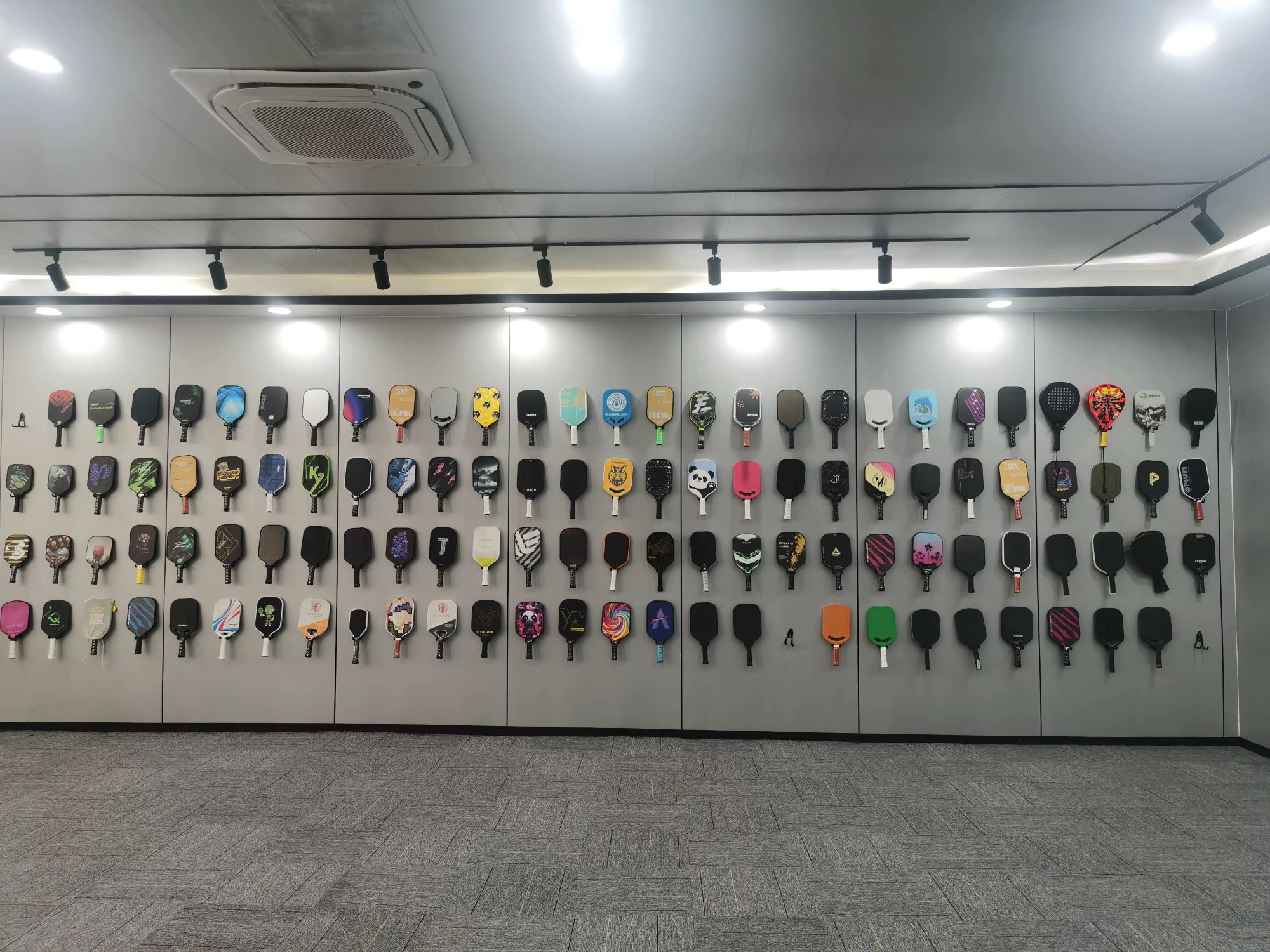
Build Your Brand with the Right OEM Pickleball Paddle Manufacturer
Developing an OEM pickleball paddle is a technical manufacturing project, not simply a logo-printing exercise.
A successful paddle requires coordinated decisions about:
- Product positioning
- Shape
- Core
- Face material
- Thickness
- Weight
- Balance
- Surface
- Handle
- Grip
- Edge construction
- Manufacturing process
- Mold
- Branding
- Packaging
- Quality control
Each component can influence the final player experience.
This is why the selection of an experienced pickleball paddle manufacturer matters.
The right manufacturing partner should be able to support the brand through product development, material selection, prototyping, tooling, manufacturing, inspection, branding, and packaging.
POM provides this integrated approach.
With a 6,000-square-meter manufacturing facility, professional production equipment, established manufacturing processes, quality-management procedures, and OEM/ODM capabilities, POM helps brands develop customized pickleball paddles and other pickleball products.
Our capabilities extend beyond a single paddle.
As a broader pickleball equipment manufacturer, POM can also provide pickleballs, portable pickleball nets, sets, and related equipment, allowing brands to develop a more complete product portfolio.
Whether you are a startup developing your first private-label paddle, an established sporting-goods company expanding into pickleball, a distributor launching a new product line, or a retailer looking for a customized paddle, the OEM process should begin with clear product objectives.
Define your player. Define your performance. Define your brand. Then work with the right OEM pickleball paddle manufacturer to turn the concept into a consistent commercial product.
POM is ready to support brands from concept → design → prototype → optimization → mass production → quality control → branded packaging.
For companies looking for a reliable pickleball paddle factory, custom pickleball paddle manufacturer, or professional pickleball equipment manufacturer, POM provides an integrated manufacturing solution designed for long-term brand development.
We have a pickleball paddles factory of skilled engineers ready to support you in your product development journey from idea design to production.Any ideas about your product you can contact us freely,and our engineers will get back to you with a quote asap. Whatsapp +86 18902611680
Who is POM?
As a leading pickleball factory, POM is committed to providing high-quality sports equipment and accessories for pickleball enthusiasts. We believe that pickleball is not only a competitive sport, but also a lifestyle.
What is your product range?
We pecialize in the design and production of high quality pickleball equipments,such as pickleball paddles,pickleball balls,pickleball nets,pickleball accessories…
Are you a manufacturer or a trader?
Can you provide samples?
•Of course, usually we will provide samples for your testing. For custom printed samples, pls send your requirements to us for checking the sample cost.
• It takes about 7 days for sample production.
Can I have my custom logo , design or size?
Sure. We can do any packaging with your design. You can still have your own logo.