
Choosing the right pickleball paddle is one of the most important equipment decisions a player can make. The paddle affects power, control, spin, maneuverability, stability, comfort, and how confidently a player can execute shots.
However, there is no universal “best pickleball paddle.” A paddle that works exceptionally well for an aggressive singles player may feel too powerful for a beginner who is learning dinks and resets. Likewise, a lightweight control paddle may be excellent at the kitchen line but not provide enough stability for a player who relies on powerful drives.
A useful way to understand paddle selection is to look at the complete product rather than focusing on one marketing specification. Paddle type, shape, grip, weight, thickness, core material, face material, surface technology, balance, handle length, and manufacturing quality all influence how a pickleball paddle performs.
Industry buying guides similarly identify weight, core material, face material, shape, grip, and playing style as major selection factors. Pickleball Central, for example, organizes its paddle guide around type, shape, grip, weight, and spin, while other current buying guides emphasize the relationship between core thickness, face material, weight, and shape.
For brands developing their own products, these same principles are even more important. A professional pickleball paddle manufacturer must translate player requirements into measurable specifications and then reproduce those specifications consistently in mass production.
This guide explains how to choose the right pickleball paddle from more than ten technical dimensions and explains how POM helps brands develop and manufacture customized pickleball equipment.
1. Pickleball Paddle Type: Start With Power, Control, or a Balanced Performance Profile
The first question when choosing a pickleball paddle should be:
What do you want the paddle to help you do?
Most paddles can broadly be categorized as:
- Control paddles
- Power paddles
- All-court or balanced paddles
A control pickleball paddle is designed to help players manage pace, execute dinks, resets, drops, and precise placement. These paddles often emphasize a softer response, stability, and a predictable sweet spot.
A power pickleball paddle is designed to generate more rebound and ball speed. It can be attractive to aggressive players who rely on drives, serves, overheads, and offensive pressure.
An all-court pickleball paddle attempts to balance power, control, spin, stability, and maneuverability.
There is no inherently superior category. The correct choice depends on the player’s technique.
A beginner often benefits from a forgiving, balanced paddle rather than an extremely powerful model. An experienced player may have enough technical control to take advantage of a higher-power design.
This power-versus-control distinction is also highlighted in professional paddle-buying guides: power paddles can add pace but require greater precision, while control paddles emphasize placement and consistency.
Simple rule: If you are not sure what type to buy, start with an all-court pickleball paddle that provides a reasonable combination of power, control, stability, and spin.
2. Pickleball Paddle Shape: Widebody, Standard, Hybrid, or Elongated?
The shape of a pickleball paddle affects reach, sweet spot size, maneuverability, and weight distribution.
Common paddle shapes include:
Widebody / Standard Shape
A wider face generally provides a larger hitting area and greater forgiveness.
This is a strong option for:
- Beginners
- Recreational players
- Doubles players
- Players who prioritize forgiveness
- Players who frequently hit off-center
Elongated Pickleball Paddle
An elongated paddle provides additional reach and can create a different balance and swing profile.
It may appeal to:
- Singles players
- Former tennis players
- Players who prefer longer reach
- Players who generate power from longer swings
The trade-off is that increasing length generally requires sacrificing some width within the applicable paddle dimensional limits.
Hybrid Pickleball Paddle
Hybrid designs attempt to combine the characteristics of standard and elongated shapes.
For many intermediate players, a hybrid pickleball paddle can provide a useful compromise between reach, maneuverability, and sweet-spot size.
Current paddle guides generally describe widebody designs as more forgiving and elongated designs as providing greater reach and power potential.
3. Pickleball Paddle Grip Size: Comfort and Control Start in Your Hand
Grip size is frequently overlooked when buying a pickleball paddle, but it can significantly influence comfort and handling.
Common adult grip circumferences are approximately:
- 4.0 inches
- 4.125 inches
- 4.25 inches
- 4.5 inches
A smaller grip can provide more freedom for wrist and hand movement, which some players prefer for spin-oriented play.
A larger grip can feel more stable for players with larger hands.
However, a grip that is too large may make the paddle difficult to maneuver and can create unnecessary hand and forearm fatigue.
When choosing between two sizes, many players are better served by starting slightly smaller because an overgrip can increase circumference, whereas reducing an oversized factory grip is more difficult.
The correct grip should feel secure without requiring excessive squeezing.
For an OEM pickleball paddle manufacturer, grip circumference, handle geometry, cushioning material, and grip tape must be treated as part of the paddle’s overall ergonomic design—not simply as cosmetic details.

4. Pickleball Paddle Weight: Lightweight vs. Midweight vs. Heavyweight
Weight is one of the most noticeable characteristics of a pickleball paddle.
A practical classification is:
- Lightweight: approximately below 7.5 oz
- Midweight: approximately 7.5–8.3 oz
- Heavyweight: approximately above 8.3 oz
Exact classifications vary among manufacturers, so buyers should focus on how the paddle actually feels rather than relying exclusively on labels.
Lightweight Pickleball Paddle
Advantages include:
- Faster hand speed
- Easier maneuverability
- Quick reaction at the kitchen
- Lower swing effort
Potential disadvantages include:
- Less stability against heavy shots
- Less inherent mass behind the ball
- Potentially less power
Heavy Pickleball Paddle
Advantages include:
- Greater stability
- More mass behind shots
- Stronger plow-through
- Potential power benefits
Potential disadvantages include:
- Slower hand speed
- Greater fatigue
- More demanding swing mechanics
A midweight paddle is often a practical starting point for players who are unsure which direction to go. Current buying guides commonly place many all-around paddles in roughly the 7.3–8.3 oz range, although individual preferences vary.
5. Pickleball Paddle Thickness: 13mm, 14mm, 16mm, or Thicker?
Core thickness is another major specification.
Modern pickleball paddles commonly use core thicknesses around 13–16 mm, although products outside this range exist.
In general:
Thinner Pickleball Paddle
A thinner core often produces:
- Faster response
- More pop
- More direct feedback
- Higher power potential
Thicker Pickleball Paddle
A thicker core often provides:
- More stability
- Softer feel
- Greater forgiveness
- More controlled response
A 16 mm pickleball paddle is frequently selected by players who prioritize control and stability, while thinner paddles are often used by players seeking a more aggressive response. However, thickness alone does not determine performance; face construction, core density, geometry, thermoforming, foam injection, and other engineering variables also matter.
For an OEM brand, this distinction is important. Simply changing a paddle from 14 mm to 16 mm does not automatically create a better control paddle. The complete structure must be engineered together.
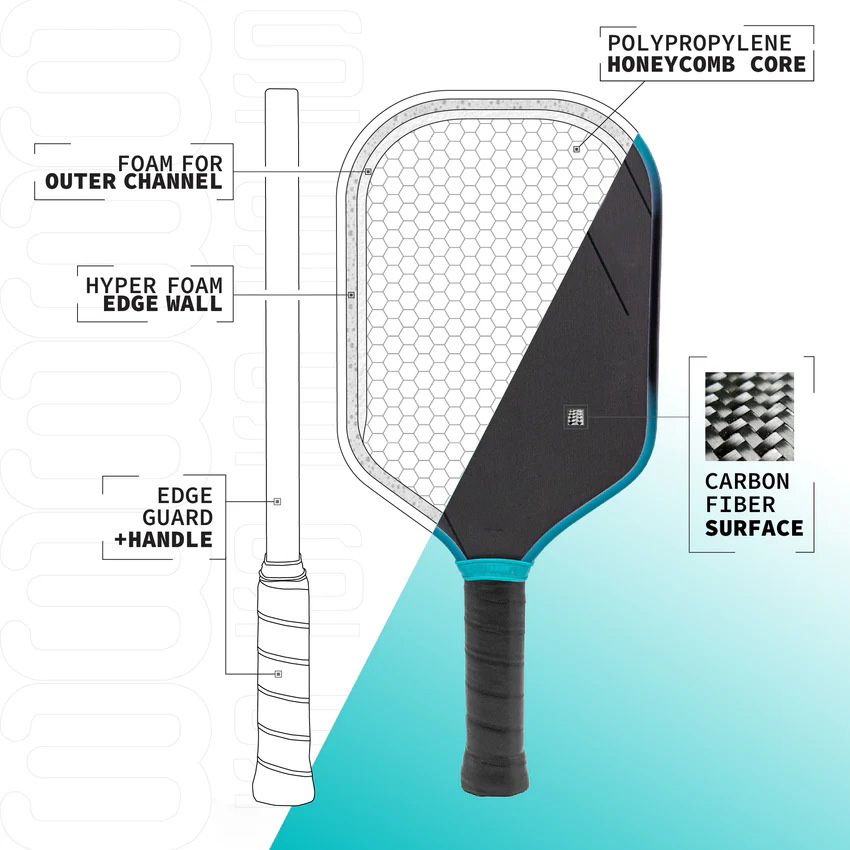
6. Pickleball Paddle Core Material: Why the Inner Honeycomb Matters
The core is the internal structure of the pickleball paddle.
Common core materials include:
Polypropylene / Polymer Honeycomb
Polymer honeycomb is one of the most widely used modern core technologies.
It can provide:
- Good control
- Vibration absorption
- Consistent response
- Relatively quiet operation
Nomex Honeycomb
Nomex has historically been associated with a harder and more responsive feel.
It can produce:
- Strong rebound
- More direct response
- A distinctive impact sound
Aluminum Honeycomb
Aluminum cores can provide a lightweight structure and distinctive response characteristics, although they are less common in many modern performance paddles than polymer cores.
Current buying guides identify polypropylene/polymer, Nomex, and aluminum as major traditional core categories, with polymer honeycomb particularly common in modern paddles.
For brands, core selection should be based on the desired playing profile rather than simply selecting the material with the strongest marketing story.
7. Pickleball Paddle Face Material: Carbon Fiber vs. Fiberglass vs. Hybrid
The face of the pickleball paddle directly interacts with the ball, so its construction has a major effect on feel and performance.
Carbon Fiber Pickleball Paddle
Carbon fiber is widely used in premium performance paddles because it can provide:
- Consistent response
- Good stiffness
- Excellent control
- Strong potential for spin
- Premium player feel
Different carbon fabrics and layup structures can produce substantially different performance.
Fiberglass Pickleball Paddle
Fiberglass tends to provide a more flexible response and can produce a lively feel.
It can be attractive for:
- Recreational players
- Power-oriented players
- Value-focused products
Hybrid Pickleball Paddle
A hybrid construction combines different materials to balance:
- Power
- Control
- Spin
- Durability
- Cost
The face material should therefore be selected together with the core rather than independently.
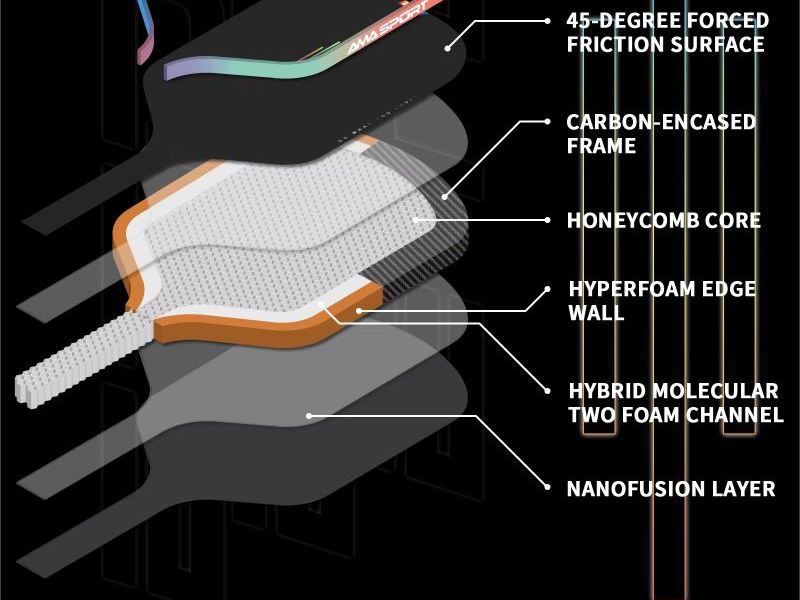
8. Pickleball Paddle Spin Technology: How Does the Surface Generate Spin?
Spin is one of the most discussed features in today’s pickleball paddle market.
A paddle’s spin performance depends on several factors, including:
- Surface texture
- Friction between paddle and ball
- Face material
- Surface treatment
- Player swing speed
- Swing path
- Paddle angle
Raw carbon fiber and other textured surfaces are commonly marketed for spin performance because the surface can increase interaction between the paddle face and ball. Current buying guides also distinguish textured/raw carbon surfaces from smoother face constructions and note that surface roughness is subject to applicable USA Pickleball equipment requirements for sanctioned play.
For an OEM manufacturer, however, spin technology must be approached carefully.
A high-friction surface is not automatically better. The surface must also be:
- Durable
- Consistent
- Repeatable
- Properly bonded
- Compliant with applicable competition rules
At POM, surface engineering is developed around the complete paddle structure rather than simply adding a rough coating.
9. Pickleball Paddle Balance: Static Weight Is Not the Whole Story
Two pickleball paddles can have exactly the same static weight but feel completely different.
Why?
Because weight distribution matters.
A paddle with more mass toward the head may feel more powerful but slower during rapid exchanges.
A paddle with more mass toward the handle can feel quicker and easier to maneuver.
This is why serious buyers should consider:
- Static weight
- Balance point
- Swing weight
- Twist stability
Swing weight describes how difficult the paddle is to accelerate and stop during rotation. It can be more useful than static weight when comparing how two paddles actually feel during play.
For an experienced pickleball paddle manufacturer, mass distribution is an engineering variable that can be adjusted through:
- Core design
- Foam injection
- Edge construction
- Handle structure
- Face material
- Weight tolerances
This is one reason a professional factory should control not only total weight but also weight distribution.
10. Pickleball Paddle Sweet Spot: Choose Forgiveness Based on Your Skill Level
The sweet spot is the area of the paddle face where impact produces a desirable combination of power, control, stability, and feel.
A larger effective sweet spot can help beginners because off-center contact is more forgiving.
A professional player may accept a smaller sweet spot if the paddle provides specific advantages in:
- Spin
- Power
- Maneuverability
- Precision
Paddle geometry, core thickness, face construction, perimeter weighting, and overall stiffness all influence the effective sweet spot.
This is another reason not to choose a pickleball paddle based on one specification alone.
A paddle advertised as “high power” may be excellent for one player and difficult to control for another.
11. Pickleball Paddle Handle Length: Standard vs. Extended Handles
Handle length is another useful selection criterion.
A standard handle is suitable for many doubles players and provides a familiar balance.
An extended handle can offer:
- More leverage
- Additional reach
- Two-handed backhand space
- A different balance profile
Players transitioning from tennis sometimes prefer a longer handle because they are already comfortable with two-handed backhands.
However, a longer handle can reduce the available face area or change paddle balance depending on the overall design.
Therefore, handle length should be evaluated together with paddle shape, balance, and playing style.
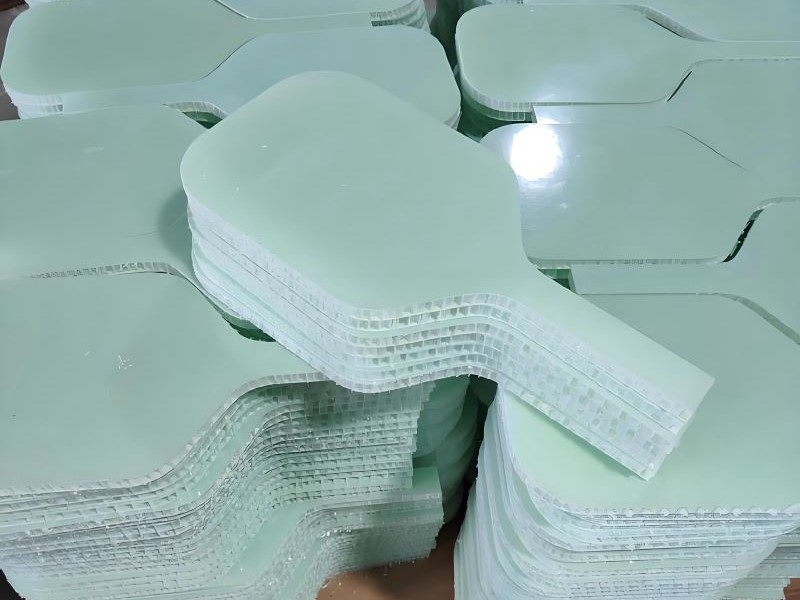
12. Pickleball Paddle Construction: Standard, Edgeless, Thermoformed, and Foam-Enhanced Designs
Modern pickleball paddles are no longer limited to simple flat composite constructions.
Current manufacturing technologies include:
Traditional Laminated Construction
Multiple layers of face material are bonded to a honeycomb core.
Advantages include:
- Mature manufacturing technology
- Flexible customization
- Cost efficiency
Thermoformed Pickleball Paddle
Thermoforming creates a more integrated structural geometry and can improve:
- Stability
- Power
- Edge rigidity
- Structural consistency
Foam-Enhanced Construction
Foam may be incorporated around the perimeter or in other structural areas to influence:
- Stability
- Vibration
- Sweet spot
- Feel
Edgeless Pickleball Paddle
Removing a traditional edge guard can reduce peripheral weight and create a different swing profile.
Each construction has advantages and disadvantages.
The right choice depends on the product’s intended market and performance target.
13. Pickleball Paddle Vibration and Comfort: Don't Ignore Feel
A technically powerful pickleball paddle can still be a poor choice if it feels uncomfortable.
Impact vibration depends on:
- Core material
- Face stiffness
- Handle structure
- Edge construction
- Foam system
- Adhesive bonding
- Weight distribution
A well-engineered paddle should provide an appropriate level of feedback without excessive unwanted vibration.
For recreational players, comfort may be more important than maximizing raw power.
For an OEM brand, vibration control is therefore an important product-development dimension, particularly when designing paddles for players who spend several hours on court.
POM’s engineering approach considers the entire structure—from core and face to edge foam, handle, grip, and bonding—to develop the intended impact sensation.
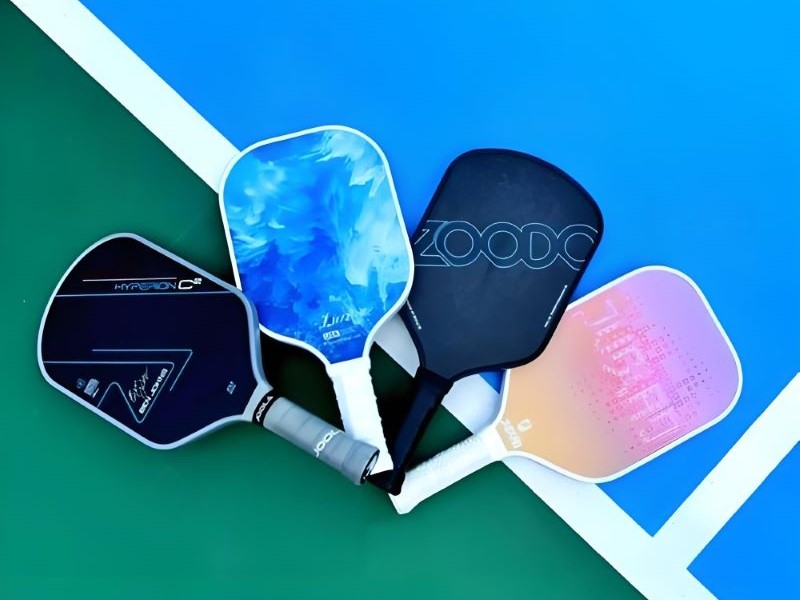
14. How to Choose a Pickleball Paddle Based on Your Playing Style
The best buying decision begins with your playing style.
If You Are a Beginner
Consider:
- Midweight construction
- Larger sweet spot
- Standard or widebody shape
- Comfortable medium grip
- Balanced power and control
- Thicker polymer core
Your priority should be forgiveness and consistency.
If You Are a Control Player
Consider:
- Thicker core
- Carbon fiber face
- Stable construction
- Moderate swing weight
- Predictable response
This profile is suitable for players who emphasize:
- Dinks
- Drops
- Resets
- Placement
- Soft-game control
If You Are a Power Player
Consider:
- Slightly heavier construction
- Thinner or power-oriented core
- Fiberglass or hybrid face
- Head-weighted balance
- Stiffer construction
If You Are a Spin Player
Prioritize:
- High-quality textured face
- Consistent surface friction
- Carbon fiber construction
- Appropriate swing weight
- Reliable surface durability
If You Play Singles
An elongated pickleball paddle may provide additional reach and leverage.
If You Mostly Play Doubles
A standard or hybrid shape can provide a useful combination of maneuverability and forgiveness.
15. Pickleball Paddle Quality: Why Manufacturing Consistency Matters
A good specification sheet does not guarantee a good product.
For brands buying hundreds or thousands of units, manufacturing consistency is critical.
Two paddles from the same production batch should have tightly controlled differences in:
- Weight
- Balance
- Thickness
- Dimensions
- Surface finish
- Grip size
- Core construction
This is where the expertise of a professional pickleball paddle factory becomes extremely important.
Manufacturing variables such as resin content, carbon fiber layup, thermoforming temperature, adhesive distribution, foam injection, curing, and edge finishing can all influence final paddle performance.
A professional pickleball paddle manufacturer therefore needs both product-development expertise and process-control capability.
16. How Brands Should Choose a Pickleball Paddle Manufacturer
If you are a brand owner rather than an individual player, your purchasing decision is different.
You are not simply choosing a paddle.
You are choosing a manufacturing partner.
Before selecting a pickleball equipment manufacturer, consider at least these questions:
- Can the factory develop custom paddle shapes?
- Can it provide OEM and ODM services?
- Can it customize carbon fiber and core structures?
- Can it control weight and balance consistently?
- Does it have experience with thermoformed paddles?
- Can it provide custom logo printing?
- Can it support packaging customization?
- Can it help with product testing and compliance?
- Can it handle different MOQ requirements?
- Can it maintain stable quality during mass production?
A low initial quotation is not necessarily the lowest total cost.
Poor consistency can create:
- Returns
- Warranty claims
- Customer complaints
- Delayed launches
- Brand damage
The better approach is to evaluate engineering capability + manufacturing quality + communication + production consistency + total cost.
17. Why Choose POM as Your Pickleball Paddle Manufacturer?
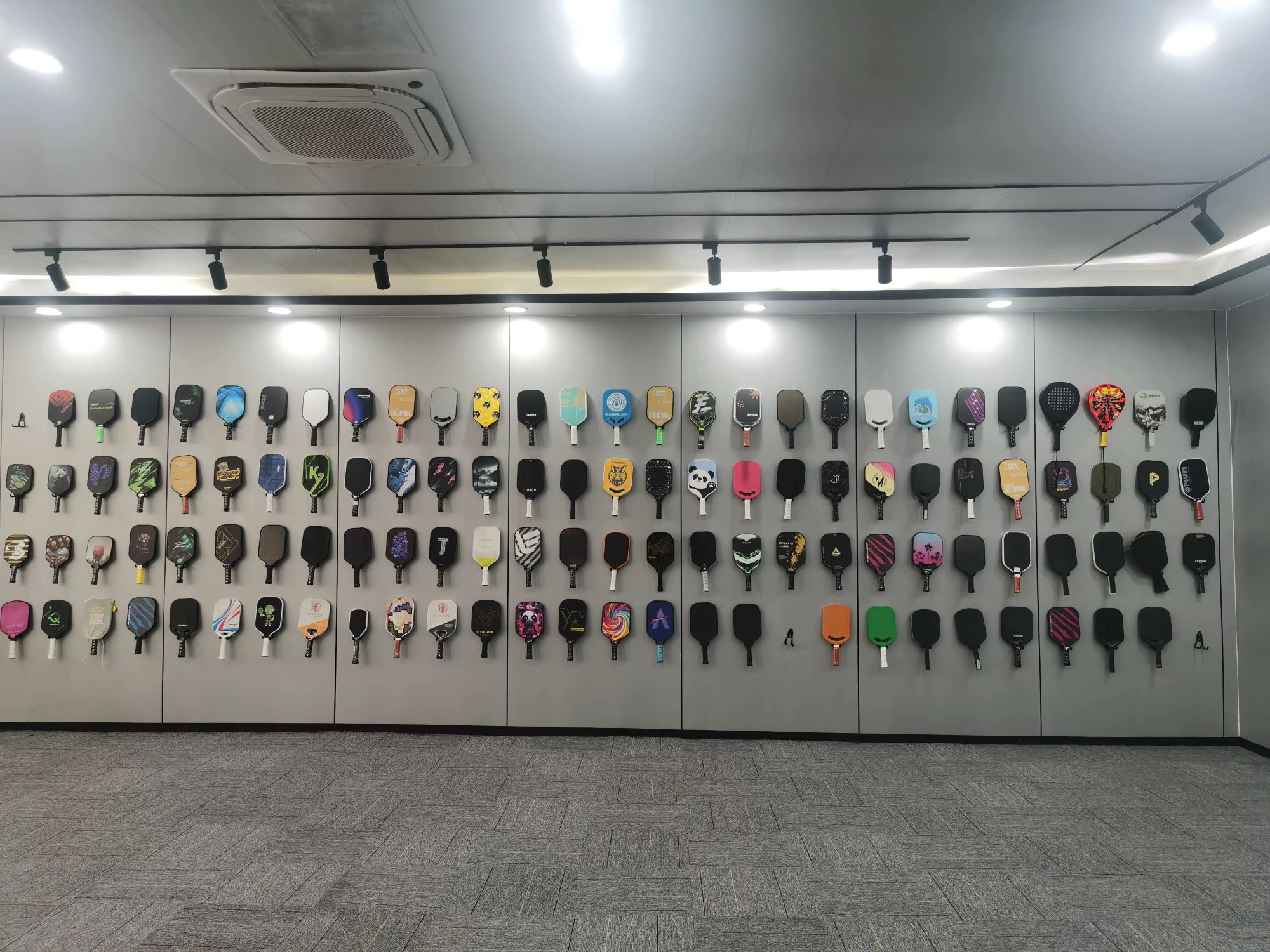
POM is a professional pickleball equipment manufacturer specializing in the development and production of pickleball sports equipment.
Our product range includes:
- Custom pickleball paddles
- Pickleballs
- Portable pickleball nets
- Complete pickleball sets
- Related pickleball accessories
We provide OEM and ODM services for brands that want to create their own products rather than simply purchase generic stock equipment.
Custom Paddle Development
POM can support customers from the initial concept through prototype development and mass production.
Our engineers can help optimize:
- Paddle shape
- Core thickness
- Core material
- Carbon fiber selection
- Face construction
- Surface texture
- Handle dimensions
- Grip design
- Weight distribution
- Edge construction
- Foam systems
Custom Branding
We can also support brand customization, including:
- Logo printing
- UV printing
- Silk-screen printing
- Custom colors
- Packaging
- Private labeling
Manufacturing Consistency
For brands, consistency is as important as performance.
POM focuses on controlling production variables so that the finished pickleball paddle remains close to the approved specification from prototype to mass production.
Our objective is simple:
Help brands develop pickleball equipment that players want to use repeatedly and that brands can confidently sell in competitive markets.
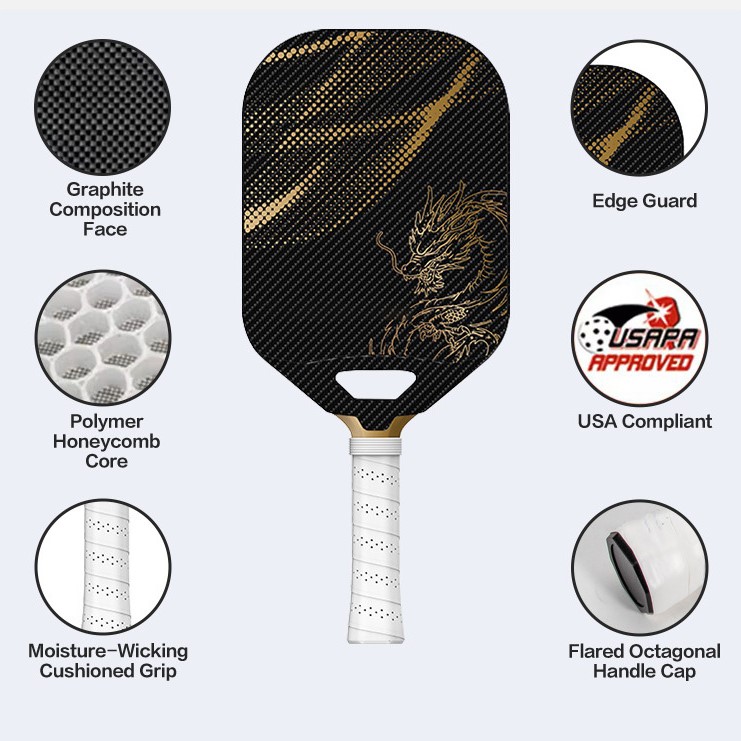
18. Pickleball Paddle Buying Checklist: 12 Questions to Ask Before You Buy
Before purchasing a pickleball paddle, ask yourself:
1. What is my playing style?
Power, control, spin, or all-court?
2. What shape do I prefer?
Widebody, standard, hybrid, or elongated?
3. What weight feels comfortable?
Lightweight, midweight, or heavyweight?
4. What core thickness do I need?
Thinner for a more direct/power-oriented response or thicker for stability and control?
5. What core material is used?
Polymer, Nomex, aluminum, or another engineered structure?
6. What face material is used?
Carbon fiber, fiberglass, graphite, or hybrid?
7. How important is spin?
If spin is important, investigate the actual surface technology rather than relying only on marketing terms.
8. Is the grip size correct?
Your hand should feel secure without excessive squeezing.
9. Is the handle length appropriate?
Especially important for two-handed backhands.
10. How does the paddle balance feel?
Static weight alone does not tell the whole story.
11. Is the paddle comfortable?
Consider vibration and impact feel.
12. Is it appropriate for your intended level of competition?
If you plan to play sanctioned events, verify the current applicable equipment approval status.
Frequently Asked Questions About Choosing a Pickleball Paddle
What is the best pickleball paddle for beginners?
For many beginners, a midweight, forgiving pickleball paddle with a relatively large sweet spot, comfortable grip, and balanced power/control profile is a sensible starting point. A standard or widebody shape and thicker polymer core are common choices.
Is a heavier pickleball paddle better?
Not necessarily. A heavier paddle can provide stability and power, but it may reduce hand speed and increase fatigue. A lighter paddle can be easier to maneuver but may provide less stability. The best weight depends on the player.
Is a 13mm or 16mm pickleball paddle better?
Neither is universally better. A thinner paddle often emphasizes responsiveness and power, while a thicker core generally emphasizes stability, control, and a softer feel. The complete construction matters more than thickness alone.
Is carbon fiber better than fiberglass for a pickleball paddle?
Carbon fiber is often selected for control, consistency, and spin-oriented performance, while fiberglass can provide a livelier, more power-oriented response. The best material depends on the player’s priorities.
Which pickleball paddle shape is best for tennis players?
Many tennis players appreciate elongated paddles because the additional reach and longer handle can feel familiar. However, standard and hybrid paddles may offer greater forgiveness and maneuverability.
Does surface texture really matter for pickleball paddle spin?
Yes. Surface texture can influence ball-to-paddle friction and therefore spin potential. However, player technique, swing speed, face angle, and surface durability also matter. For competitive products, brands should ensure that surface construction complies with applicable equipment rules.
How should a brand choose a pickleball paddle factory?
Look beyond unit price. Evaluate engineering capabilities, materials, prototype development, quality control, manufacturing consistency, customization capabilities, compliance support, and communication.
The Best Pickleball Paddle Is the One That Matches the Player
Choosing the right pickleball paddle is ultimately an exercise in matching equipment characteristics with player requirements.
There are at least ten important dimensions to consider:
- Paddle type
- Shape
- Grip size
- Weight
- Thickness
- Core material
- Face material
- Spin technology
- Balance
- Handle length
- Sweet spot
- Construction technology
- Vibration and comfort
- Manufacturing consistency
The most expensive pickleball paddle is not automatically the best paddle, and the newest technology is not automatically the right technology for every player.
Instead, start with your playing style.
If you need control, prioritize stability, feel, and forgiveness. If you need power, consider a more responsive construction and appropriate weight distribution. If spin is your priority, investigate the face material and surface technology. If comfort matters most, pay close attention to grip, vibration, balance, and swing weight.
For brands, the same principle applies on a larger scale. The right product starts with the right specifications—but it succeeds only when those specifications can be manufactured consistently.
As an experienced pickleball paddle manufacturer, pickleball paddle factory, and pickleball equipment manufacturer, POM combines product development, material selection, engineering optimization, OEM manufacturing, and brand customization to help customers transform their ideas into reliable pickleball products.
The right paddle is not simply the paddle with the most features. It is the paddle whose design, materials, balance, feel, and performance work together for the player.
And for brands, the right manufacturing partner is the one that can turn that performance concept into a consistent product at scale.
We have a pickleball paddles factory of skilled engineers ready to support you in your product development journey from idea design to production.Any ideas about your product you can contact us freely,and our engineers will get back to you with a quote asap. Whatsapp +86 18902611680
Who is POM?
As a leading pickleball factory, POM is committed to providing high-quality sports equipment and accessories for pickleball enthusiasts. We believe that pickleball is not only a competitive sport, but also a lifestyle.
What is your product range?
We pecialize in the design and production of high quality pickleball equipments,such as pickleball paddles,pickleball balls,pickleball nets,pickleball accessories…
Are you a manufacturer or a trader?
Can you provide samples?
•Of course, usually we will provide samples for your testing. For custom printed samples, pls send your requirements to us for checking the sample cost.
• It takes about 7 days for sample production.
Can I have my custom logo , design or size?
Sure. We can do any packaging with your design. You can still have your own logo.