

In the competitive landscape of the sports equipment industry, a pickleball equipment manufacturer is often judged not by the initial aesthetics of their product, but by its structural survival. For procurement managers, the most frustrating feedback from the field is “core delamination”—that dreaded “crunchy sound” or “hollow vibration” that occurs when the face of a pickleball paddle separates from its internal honeycomb structure. This failure usually happens after approximately 50 to 100 hours of high-intensity play, long after the factory QC phase has passed. Understanding the mechanical relationship between the pickleball paddle core and the bonding process (Cold Press vs. Thermoformed) is the only way to ensure your brand avoids the catastrophic costs of mass product recalls.
1. The Anatomy of a High-Performance Pickleball Paddle Core
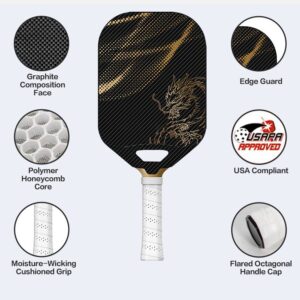
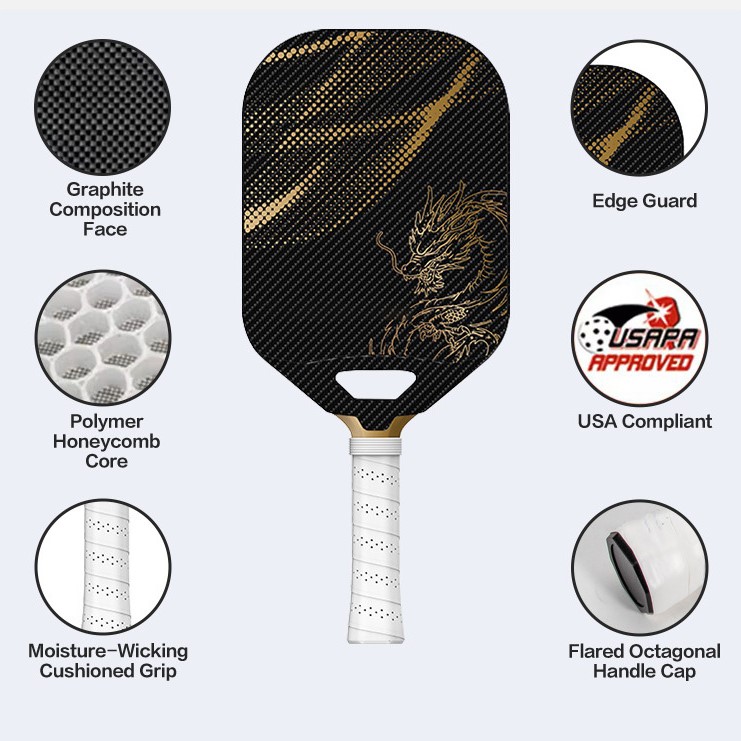
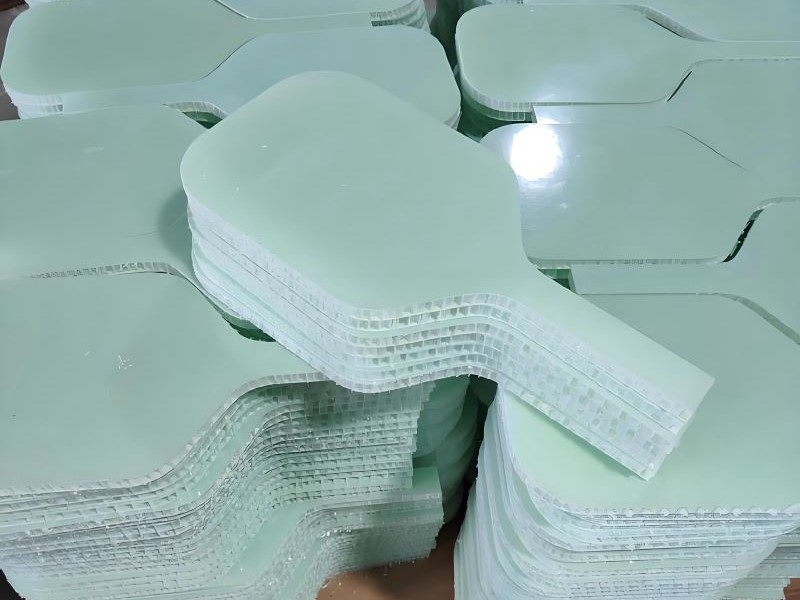
To understand why failure occurs, one must first analyze the composition of the pickleball paddle core. Most professional-grade pickleball paddles utilize a Polypropylene (PP) honeycomb core due to its superior energy absorption and noise-dampening properties. However, there are variations including Nomex (aramid fiber), Aluminum, and specialized polymer blends. As a leading pickleball paddle factory, POM recognizes that the “cell size” and “wall thickness” of these honeycombs dictate the surface area available for bonding. If the surface area is too small or the resin doesn’t “wet” the honeycomb edges correctly, the paddle is structurally compromised from day one, leading to early-stage delamination during tournament play.
2. Comparing Core Materials: Polypropylene, Nomex, and Aluminum
When sourcing from a pickleball equipment manufacturer, the choice of core material defines the paddle’s “DNA.” Polypropylene is the industry standard for carbon fiber pickleball paddles because it offers a “soft” feel and durability. Nomex cores are harder and louder, offering more “pop” but are significantly more prone to “core crush”—where the honeycomb cells flatten under repeated impact. Aluminum cores offer the most power but suffer from permanent denting. For a procurement officer, selecting a high-density PP pickleball paddle core is generally the safest bet for balancing longevity with the performance demands of modern players.

3. The Traditional Cold Press Process: Why It Leads to Delamination
The “Cold Press” method has been the backbone of the pickleball paddle factory for years. In this process, the pickleball paddle core, epoxy resin, and carbon fiber faces are stacked and compressed at room temperature. While cost-effective, the bond created is purely mechanical. Over time, the repeated “flex and snap” of the paddle face during power shots creates micro-tears in the epoxy. This is the primary cause of the “crunchy sound”—the sound of dried resin flakes rubbing against the honeycomb. If your brand relies on cold-pressed pickleball paddles, you must account for a higher RMA (Return Merchandise Authorization) rate compared to advanced manufacturing methods.
4. The Rise of Thermoformed Pickleball Paddles: Engineering a Monocoque Structure
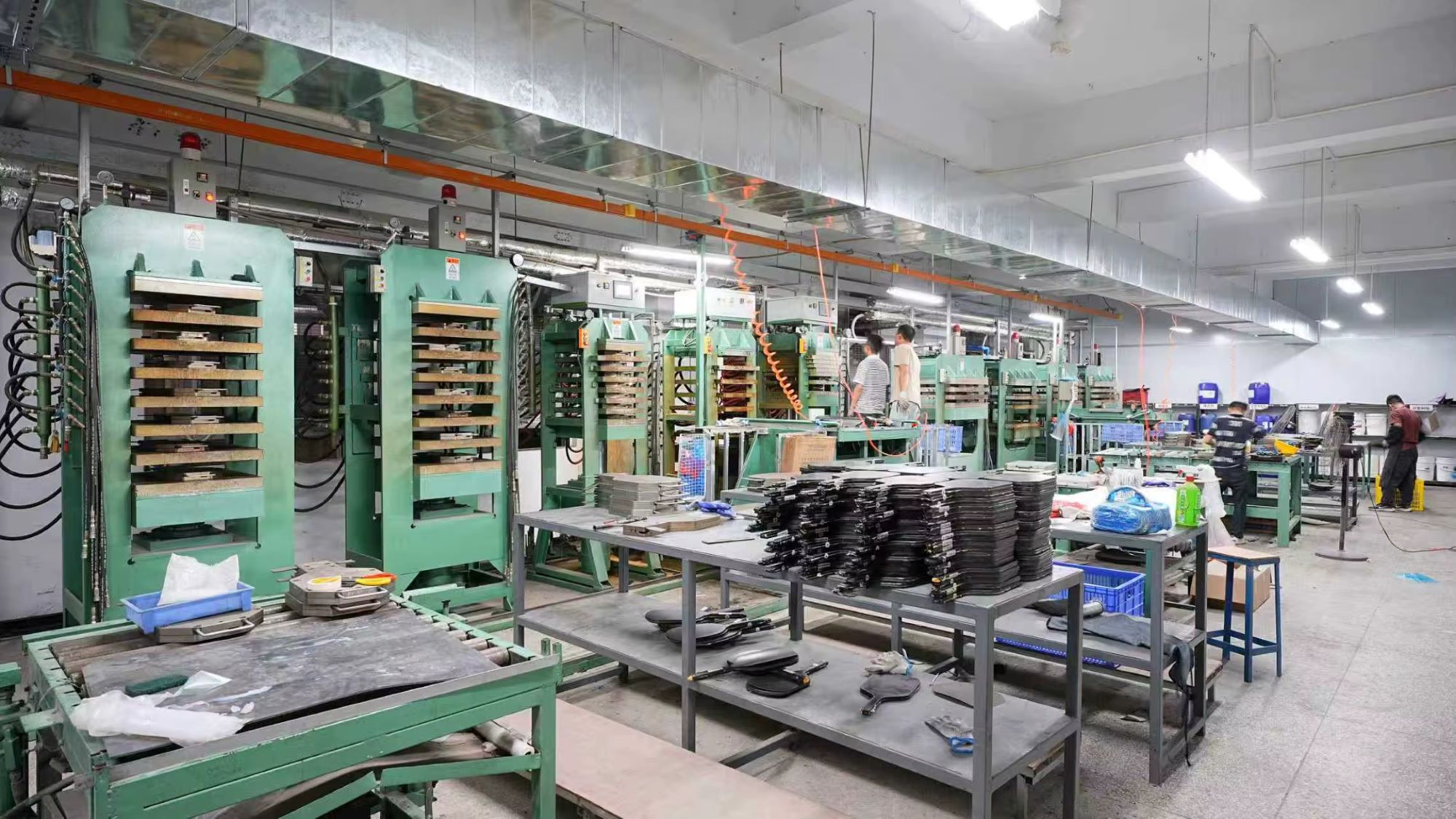
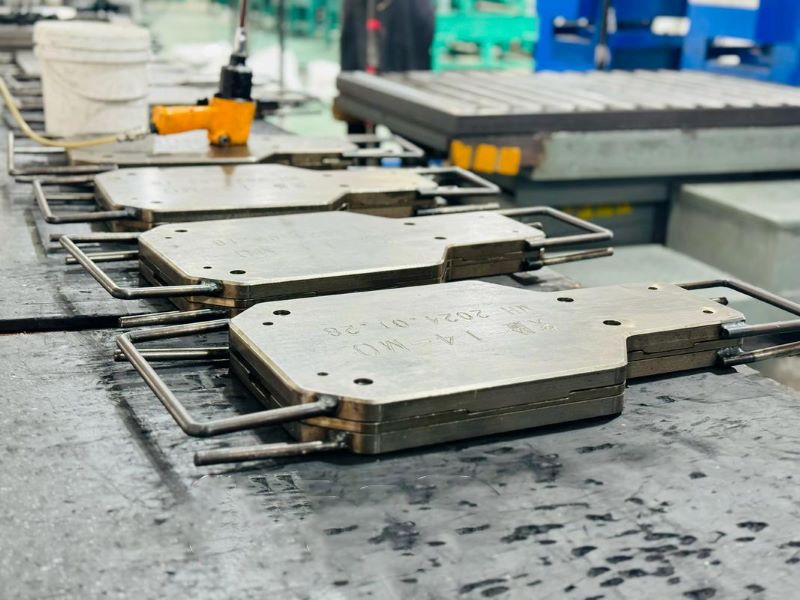
The industry is currently shifting toward “Thermoforming,” a process where the pickleball paddle is molded under high heat and extreme pressure. Unlike cold pressing, thermoforming creates a “monocoque” or single-body structure. The heat allows the resin to flow into the honeycomb cells, creating a chemical bond rather than just a surface-level stick. This is why thermoformed pickleball paddles are significantly more resistant to delamination. As a specialized pickleball equipment manufacturer, POM utilizes precise heat-cycling to ensure the carbon fiber wrap integrates perfectly with the core, virtually eliminating internal collapse.
5. Solving the "Crunchy Sound" Through Edge Foam Injection
One of the most effective ways a pickleball paddle factory can prevent core failure is through perimeter foam injection. By injecting a high-density structural foam around the edges of the pickleball paddle core, the manufacturer creates a rigid “frame” that supports the face-to-core bond. This prevents the “peeling” effect that starts at the edges of the paddle. When sourcing carbon fiber pickleball paddles, always ask if the supplier uses edge-foam reinforcement. This technical detail is often the difference between a paddle that lasts 3 months and one that lasts 2 years.
6. How Manufacturing Temperature Affects Pickleball Paddle Longevity
Temperature control during the bonding process is a critical “black box” in pickleball equipment manufacturing. If the resin is cured too quickly at a very high temperature, it becomes brittle. If cured too slowly, the bond is weak. A professional pickleball paddle factory like POM uses multi-stage ramp-up and ramp-down temperature protocols. This ensures the epoxy resin retains enough elasticity to handle the high-velocity impact of a pickleball without cracking. A brittle resin is the #1 culprit behind the internal “honeycomb collapse” that plagues low-tier OEMs.
7. The Impact of Carbon Fiber Ply Orientation on Core Tension
The durability of the pickleball paddle core is also dependent on the “skin” tension. By using multi-directional carbon fiber (alternating 0°, 45°, and 90° angles), a pickleball equipment manufacturer can distribute the impact force across a wider area of the honeycomb. If the carbon fiber is only laid in one direction, the impact energy is concentrated on a single row of honeycomb cells, leading to localized “soft spots.” Premium carbon fiber pickleball paddles utilize a cross-weave pattern that protects the core from focused fatigue.
8. Identifying Internal Honeycomb Collapse Before Shipping
How can a buyer detect a faulty pickleball paddle before it reaches the customer? Advanced factories use “Deflection Mapping.” By applying a standardized load across different points on the paddle face, we can identify “deviations” in the core’s resistance. If one area of the pickleball paddle core deflects more than the others, it indicates an internal bonding void. At POM, our QC protocols include acoustic resonance testing—listening for specific frequencies that indicate a perfect bond between the face and the core.
9. Thermal Expansion and Supply Chain Risks
Paddles are often manufactured in Asia and shipped in containers where internal temperatures can exceed 60°C (140°F). If a pickleball equipment manufacturer uses low-grade bonding agents, the heat during transit can “pre-weaken” the bond before the player ever hits a ball. This is why POM insists on using aerospace-grade adhesives with a high Glass Transition Temperature (Tg). Our pickleball paddles are engineered to survive the rigors of global logistics without losing their structural integrity.
10. Customizing the "Feel": How Core Thickness Changes Performance
When designing a custom line, the thickness of the pickleball paddle core (typically 13mm, 14mm, or 16mm) dictates the “Power vs. Control” ratio. Thicker 16mm cores provide more vibration dampening and control but require a more robust bonding process because the “lever arm” of the paddle face is longer. A 16mm carbon fiber pickleball paddle is actually more prone to delamination if the bonding process isn’t optimized for the increased depth. Choosing a factory that understands these physics is vital for your product development.
11. The Role of Resin Infusion in Preventing "Dead Spots"
A “dead spot” is effectively a localized area of delamination where the face has lost contact with the pickleball paddle core. To prevent this, POM uses a vacuum-assisted resin infusion process in our thermoformed pickleball paddles. This ensures that the resin is evenly distributed across every single “cell wall” of the honeycomb. Traditional “hand-roll” methods used by many factories often leave “dry spots” that inevitably become dead spots after the first 50 hours of play.
12. Why POM is the Premier Partner for Pickleball Equipment Manufacturing
Sourcing from POM means gaining access to a pickleball paddle factory that prioritizes engineering over marketing. We have solved the “crunchy sound” problem through a combination of Toray T700 raw carbon fiber, high-pressure thermoforming, and proprietary edge-seal technology. Our long-term partnerships with major brands are built on the fact that our pickleball paddles maintain their USAPA deflection and structural standards long after the competition’s products have failed.
13. How to Choose the Correct Manufacturing Process for Your Brand
If you are targeting the “Value” segment, Cold Pressing may be acceptable, provided you have a strict QC team. However, if you are building a “Premium” or “Pro” brand, Thermoforming is non-negotiable. The modern player is too educated to accept a paddle that loses its “pop” in three months. Working with a pickleball equipment manufacturer like POM allows you to offer a “Lifetime Bond Guarantee” to your customers—a powerful marketing tool that is only possible with superior manufacturing.
14. Protecting Your Investment in Pickleball Gear
The “crunchy sound” and “honeycomb collapse” are not inevitable parts of a paddle’s lifecycle—they are symptoms of subpar manufacturing. By focusing on the bonding science and the structural integrity of the pickleball paddle core, you can differentiate your brand in a crowded market. Avoid the “Marketing Carbon” traps and invest in the proven engineering of thermoformed carbon fiber pickleball paddles.
15. Partner with POM for Custom Pickleball Excellence
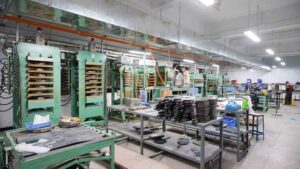
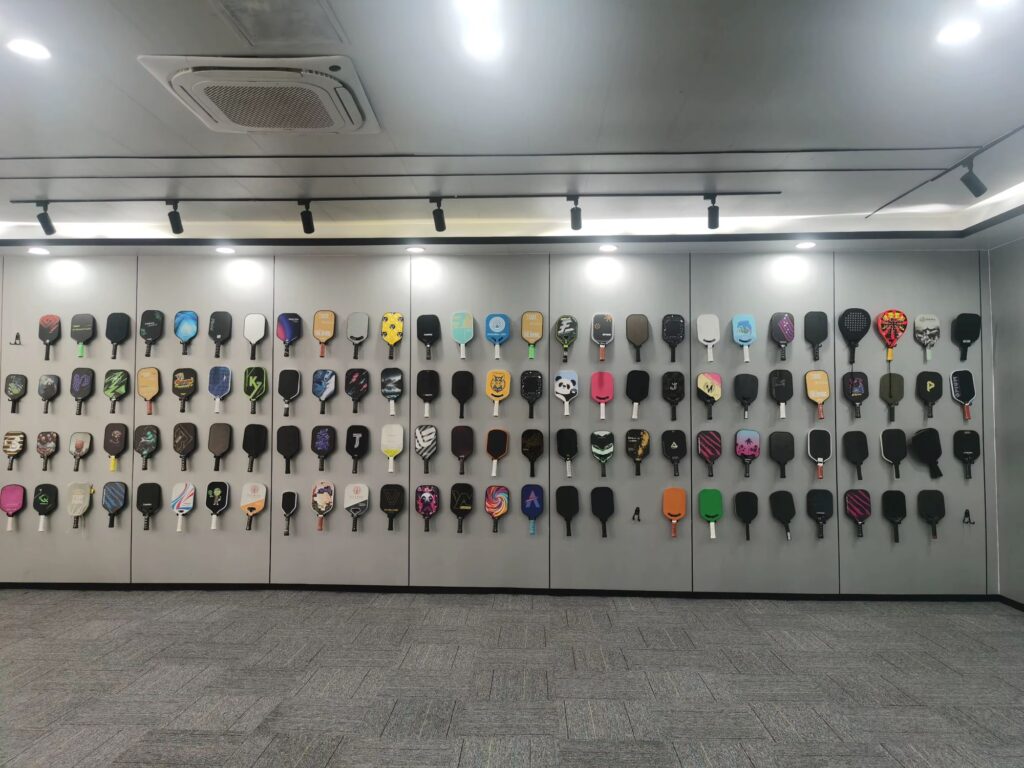
Ready to eliminate delamination from your product line? POM is your trusted pickleball equipment manufacturer, offering world-class OEM/ODM services for pickleball paddles, balls, and portable net systems. Our facility in Dongguan is equipped with the latest thermoforming technology to ensure your brand stands for quality and durability. Contact us today to start your journey toward manufacturing the most reliable pickleball paddles on the market.
We have a pickleball paddles factory of skilled engineers ready to support you in your product development journey from idea design to production.Any ideas about your product you can contact us freely,and our engineers will get back to you with a quote asap. Whatsapp +86 18902611680
Who is POM?
As a leading pickleball factory, POM is committed to providing high-quality sports equipment and accessories for pickleball enthusiasts. We believe that pickleball is not only a competitive sport, but also a lifestyle.
What is your product range?
We pecialize in the design and production of high quality pickleball equipments,such as pickleball paddles,pickleball balls,pickleball nets,pickleball accessories…
Are you a manufacturer or a trader?
Can you provide samples?
•Of course, usually we will provide samples for your testing. For custom printed samples, pls send your requirements to us for checking the sample cost.
• It takes about 7 days for sample production.
Can I have my custom logo , design or size?
Sure. We can do any packaging with your design. You can still have your own logo.