Last Updated on 2026-01-01 by Pickleball Expert
Why Injury Knowledge Matters in Pickleball
Pickleball is widely recognized as one of the most accessible and joint-friendly racket sports in the world. Its smaller court size, underhand serve, and relatively moderate movement demands make it attractive to players of all ages, particularly middle-aged and senior participants. However, despite its reputation as a low-impact sport, pickleball is not injury-free.
As participation increases globally, so does the incidence of acute and overuse injuries, particularly among recreational players who may lack formal training, conditioning, or injury prevention education. From a sports science perspective, understanding how injuries occur, how to respond immediately, and how to recover safely is essential for long-term performance, player safety, and sustainable participation.
As POM, a professional manufacturer of pickleball paddles, competition balls, and related equipment, we view injury management as a critical component of the pickleball ecosystem. Equipment design, playing technique, physical conditioning, and emergency response all work together to reduce injury risk and severity.
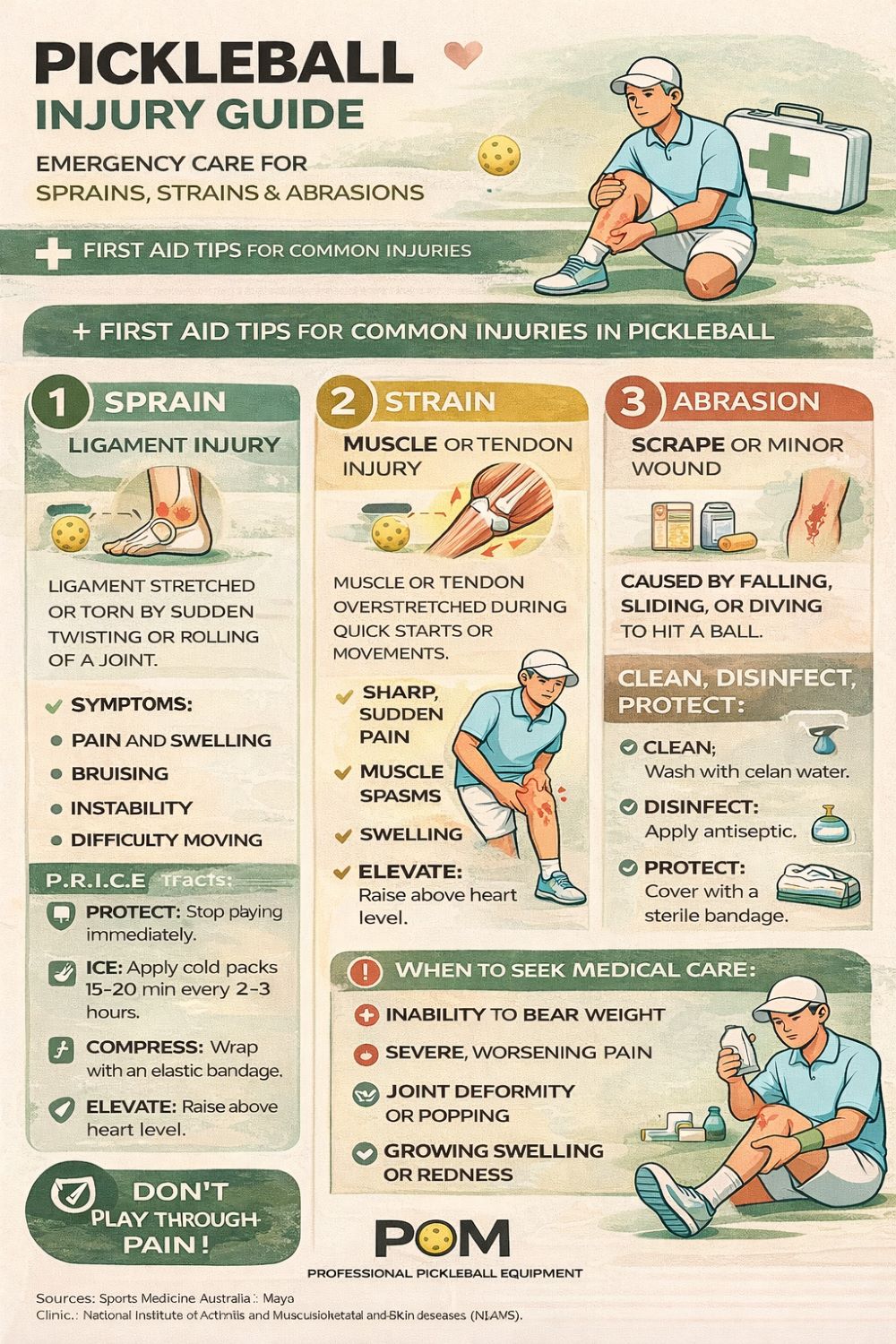
This article provides a comprehensive, evidence-based emergency injury guide focusing on the most common pickleball injuries:
Sprains
Muscle strains
Skin abrasions and minor wounds
It is intended for players, coaches, club managers, and distributors seeking reliable, science-backed guidance.
1. Common Pickleball Injuries: A Sports Science Overview
1.1 Why Injuries Occur in Pickleball
From a biomechanical standpoint, pickleball injuries often result from:
Sudden changes of direction
Lateral shuffling and lunging
Inadequate warm-up
Poor footwear or surface traction
Fatigue and reduced neuromuscular control
Although the sport is lower impact than tennis, the stop-and-go movement patterns place stress on joints, muscles, and connective tissues.
1.2 Injury Categories in Pickleball
Most pickleball injuries fall into three primary categories:
Sprains (ligament injuries)
Strains (muscle or tendon injuries)
Abrasions and minor skin trauma
Understanding the differences between these injuries is essential for appropriate first aid and recovery.
2. Sprains in Pickleball: Causes, Symptoms, and Emergency Care
2.1 What Is a Sprain?
A sprain is an injury to a ligament, the fibrous tissue that connects bones at a joint. In pickleball, sprains most commonly affect:
Ankle
Knee
Wrist
2.2 Common Causes of Sprains in Pickleball
Sudden lateral movement
Landing awkwardly after reaching for a ball
Slipping on dusty or uneven court surfaces
Wearing footwear with inadequate lateral support
2.3 Signs and Symptoms of a Sprain
Pain around the joint
Swelling
Bruising
Reduced range of motion
Joint instability in more severe cases
2.4 Immediate Emergency Response for Sprains
The gold-standard initial response follows the P.R.I.C.E. protocol:
Protection
Stop play immediately
Avoid weight-bearing if pain is significant
Rest
Prevent further stress on the injured joint
Ice
Apply cold packs for 15–20 minutes
Repeat every 2–3 hours during the first 24–48 hours
Compression
Use an elastic bandage to limit swelling
Ensure compression is firm but not restrictive
Elevation
Raise the injured limb above heart level when possible
2.5 When to Seek Medical Attention
Immediate medical evaluation is recommended if:
Pain is severe
Joint appears deformed
Weight-bearing is impossible
Swelling increases rapidly
3. Muscle Strains in Pickleball: Understanding Soft Tissue Injuries
3.1 What Is a Muscle Strain?
A muscle strain occurs when muscle fibers or tendons are overstretched or torn. In pickleball, strains frequently affect:
Calf muscles
Hamstrings
Quadriceps
Forearm muscles
3.2 Why Muscle Strains Are Common in Pickleball
From a sports physiology perspective, strains often occur due to:
Explosive movements without proper warm-up
Fatigue-induced coordination loss
Repetitive stroke mechanics
Sudden acceleration or deceleration
3.3 Symptoms of Muscle Strains
Sudden sharp pain
Muscle tightness or cramping
Swelling or bruising
Reduced strength or flexibility
3.4 Immediate First Aid for Muscle Strains
The same P.R.I.C.E. protocol applies, with additional emphasis on:
Avoiding aggressive stretching during the acute phase
Preventing heat application in the first 48 hours
3.5 Grades of Muscle Strains
| Grade | Severity | Recovery Time |
|---|---|---|
| Grade I | Mild overstretch | 1–2 weeks |
| Grade II | Partial tear | 3–6 weeks |
| Grade III | Complete tear | Medical intervention required |
4. Skin Abrasions and Minor Wounds in Pickleball
4.1 Why Abrasions Occur in Pickleball
Abrasions typically result from:
Diving or falling during play
Sliding on hard court surfaces
Contact with rough court textures
Although often considered minor, improper wound care can lead to infection and delayed healing.
4.2 Identifying Abrasions
Superficial skin damage
Bleeding or oozing
Localized pain or burning sensation
4.3 Emergency Care for Abrasions
Step 1: Clean the Wound
Rinse with clean water or saline
Remove visible debris gently
Step 2: Disinfect
Use an antiseptic solution
Avoid harsh chemicals that damage tissue
Step 3: Protect
Apply sterile dressing or bandage
Keep wound covered during activity
4.4 Signs of Infection to Monitor
Increasing redness
Swelling
Warmth
Pus or discharge
Fever
Seek medical care if infection is suspected.


5. The Role of Equipment in Injury Prevention and Management
5.1 Footwear and Joint Protection
Proper pickleball footwear should provide:
Lateral stability
Adequate cushioning
Court-specific traction
Inadequate shoes significantly increase the risk of ankle and knee sprains.
5.2 Paddle Design and Upper-Limb Injuries
From a biomechanical standpoint, paddle characteristics influence:
Wrist load
Elbow stress
Shoulder fatigue
Balanced paddle weight and appropriate grip size help reduce strain injuries.
5.3 Ball Speed and Injury Risk
Ball hardness and rebound affect:
Reaction time
Stroke force
Overuse injury risk
As a manufacturer, POM designs equipment to support consistent play mechanics and injury reduction.
6. Immediate On-Court Injury Response: Best Practices
6.1 Stop Play Immediately
Continuing play increases injury severity and recovery time.
6.2 Assess Before Moving
Check for:
Severe pain
Deformity
Loss of sensation
6.3 Avoid “Playing Through Pain”
Sports science research consistently shows that early intervention reduces long-term damage.


7. Post-Injury Recovery and Return-to-Play Principles
7.1 Gradual Loading
Return to play should follow:
Pain-free range of motion
Restored strength
Neuromuscular control
7.2 Importance of Rehabilitation
Rehabilitation exercises improve:
Tissue healing
Joint stability
Movement efficiency
Skipping rehab significantly increases reinjury risk.
8. Injury Prevention Strategies for Pickleball Players
8.1 Warm-Up and Cool-Down
Dynamic warm-ups improve:
Muscle elasticity
Reaction time
Injury resilience
Cool-downs aid circulation and recovery.
8.2 Strength and Mobility Training
Target areas:
Ankles and calves
Knees and hips
Core and shoulders
Balanced conditioning supports injury resistance.


9. Age-Related Considerations in Injury Management
9.1 Older Players
Slower tissue healing
Reduced flexibility
Higher reinjury risk
Extra emphasis on warm-up, hydration, and recovery is essential.
9.2 Recreational vs Competitive Players
Competitive intensity increases injury risk; structured recovery becomes more important.
10. The Role of Education and Preparedness
Clubs and facilities should:
Maintain first-aid kits
Train staff in basic injury response
Educate players on injury signs
Prepared environments reduce injury severity and downtime.


11. Pickleball Injury Trends and Data Insights
Industry observations show:
Ankle sprains are the most common acute injury
Muscle strains increase with fatigue
Abrasions occur more frequently on outdoor courts
Understanding trends helps guide prevention strategies.
12. When to Resume Play After Injury
Return-to-play criteria include:
No pain during movement
Full range of motion
Strength symmetry
Confidence in movement
Rushing back increases chronic injury risk.


13. Manufacturer Responsibility in Player Safety
As a professional pickleball equipment manufacturer, POM prioritizes:
Ergonomic paddle design
Consistent ball performance
Equipment safety testing
High-quality equipment supports safer play environments.
14. Integrating Injury Awareness into Pickleball Culture
Promoting injury awareness:
Improves player longevity
Enhances enjoyment
Reduces medical costs
A well-informed player base strengthens the entire pickleball ecosystem.


Safer Play Through Knowledge and Preparation
Pickleball is a sport built on accessibility, enjoyment, and community—but long-term participation depends on injury awareness and proper response. From sprains and muscle strains to minor abrasions, understanding how to react immediately and recover properly is essential for players at every level.
By combining sports science principles, appropriate equipment, and informed decision-making, pickleball can remain a safe, sustainable, and health-promoting sport worldwide.
At POM, we remain committed to supporting not only performance—but also player safety, injury prevention, and responsible participation through professional equipment and educational resources.
We have a pickleball paddles factory of skilled engineers ready to support you in your product development journey from idea design to production.Any ideas about your product you can contact us freely,and our engineers will get back to you with a quote asap. Whatsapp +86 18902611680
Who is POM?
As a leading pickleball factory, POM is committed to providing high-quality sports equipment and accessories for pickleball enthusiasts. We believe that pickleball is not only a competitive sport, but also a lifestyle.
What is your product range?
We pecialize in the design and production of high quality pickleball equipments,such as pickleball paddles,pickleball balls,pickleball nets,pickleball accessories…
Are you a manufacturer or a trader?
Can you provide samples?
•Of course, usually we will provide samples for your testing. For custom printed samples, pls send your requirements to us for checking the sample cost.
• It takes about 7 days for sample production.
Can I have my custom logo , design or size?
Sure. We can do any packaging with your design. You can still have your own logo.