
Last Updated on 2025-12-27 by Pickleball Expert
Pickleball as a Heart-Healthy Global Sport
Pickleball has evolved far beyond its origins as a recreational backyard game. Today, it is one of the fastest-growing sports worldwide, embraced by players across age groups, fitness levels, and geographic regions. While pickleball is often praised for its social accessibility and low learning barrier, its cardiovascular health benefits are increasingly recognized by sports scientists, medical professionals, and public health organizations.
In an era where cardiovascular disease remains the leading cause of mortality globally, physical activities that are safe, sustainable, and enjoyable play a crucial role in prevention and long-term heart health. Pickleball stands out because it delivers meaningful cardiovascular stimulation without the excessive joint stress or injury risk commonly associated with high-impact sports.
As POM, a professional manufacturer of pickleball paddles, competition-grade balls, and related equipment, we view pickleball not only as a sport—but as a cardiovascular wellness tool. Understanding the physiological impact of pickleball on the heart allows players, clubs, and institutions to make informed decisions about training, equipment selection, and participation programs.
This article provides a comprehensive sports science analysis of how pickleball affects cardiovascular health, supported by exercise physiology principles, heart-rate research, and comparative fitness data.
1. Cardiovascular Health: A Sports Science Overview
1.1 What Is Cardiovascular Health?
Cardiovascular health refers to the optimal functioning of the heart, blood vessels, and circulatory system. Key indicators include:
Resting heart rate
Blood pressure
Cardiac output
Oxygen uptake (VO₂)
Blood lipid profiles
Vascular elasticity
Regular aerobic physical activity is one of the most effective ways to improve these markers.
1.2 How Exercise Improves Heart Health
From a physiological perspective, aerobic exercise leads to:
Increased stroke volume (heart pumps more blood per beat)
Lower resting heart rate
Improved oxygen delivery to muscles
Enhanced blood vessel flexibility
Reduced systemic inflammation
Pickleball fits squarely within the category of moderate-to-vigorous aerobic exercise, depending on playing intensity.
2. Where Pickleball Fits in Cardiovascular Training Zones
2.1 Heart Rate Zones Explained
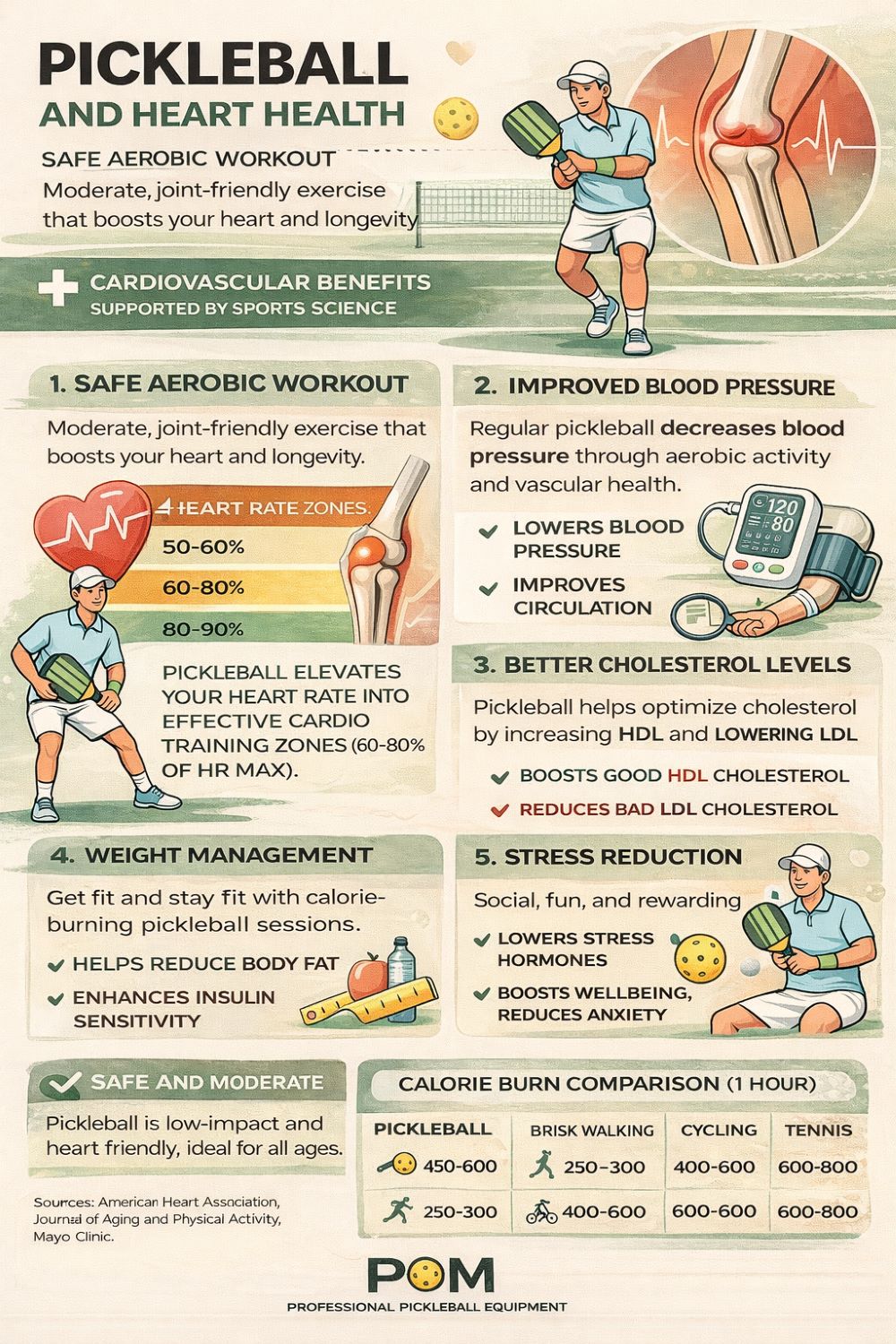
Exercise intensity is commonly classified into heart rate zones:
| Zone | % of HR Max | Health Effect |
|---|---|---|
| Zone 1 | 50–60% | Recovery |
| Zone 2 | 60–70% | Aerobic base, fat metabolism |
| Zone 3 | 70–80% | Cardiovascular conditioning |
| Zone 4 | 80–90% | Performance, anaerobic threshold |
2.2 Heart Rate Response During Pickleball
Sports science studies and wearable data consistently show that pickleball players spend most of their time in:
Zone 2–3 during recreational doubles
Zone 3–4 during competitive doubles and singles
This places pickleball in the ideal cardiovascular conditioning range, especially for adults and seniors.
3. Caloric Expenditure and Cardiac Demand in Pickleball
3.1 Energy Expenditure Supports Heart Function
Calorie burn is directly related to cardiovascular workload. Pickleball typically burns:
420–500 kcal/hour (doubles)
600–750 kcal/hour (singles)
This level of expenditure is sufficient to:
Improve cardiac efficiency
Reduce body fat (a major cardiovascular risk factor)
Improve insulin sensitivity
3.2 Interval Nature of Pickleball
Pickleball is not continuous steady-state exercise. Instead, it features:
Short bursts of activity
Brief recovery phases
Repeated acceleration and deceleration
This interval-like pattern has been shown to improve cardiovascular health more effectively than steady-state exercise alone.
4. Pickleball as Moderate-Intensity Aerobic Exercise
4.1 Why Moderate Intensity Matters
Public health guidelines recommend:
At least 150 minutes per week of moderate-intensity aerobic exercise
Pickleball allows players to meet or exceed these guidelines naturally through enjoyable play rather than forced workouts.
4.2 Sustained Participation and Adherence
One of the most important factors in cardiovascular health is long-term adherence. Pickleball’s social and competitive structure leads to:
Longer play sessions
Higher weekly frequency
Greater consistency over months and years
This makes pickleball particularly effective as a lifelong heart-health activity.


5. VO₂ and Oxygen Utilization in Pickleball
5.1 Understanding VO₂
VO₂ (oxygen uptake) is a primary indicator of cardiovascular fitness. Higher VO₂ values reflect:
Stronger heart function
Better oxygen delivery
Improved endurance
5.2 Pickleball’s Effect on VO₂
Research comparing racket sports indicates that pickleball:
Produces moderate-to-high VO₂ demand
Improves aerobic capacity over time
Is especially effective for previously sedentary individuals
For older adults, even modest VO₂ improvements significantly reduce cardiovascular mortality risk.
6. Blood Pressure and Circulatory Benefits
6.1 Pickleball and Blood Pressure Reduction
Regular aerobic exercise has been shown to:
Reduce systolic blood pressure by 5–10 mmHg
Improve vascular elasticity
Pickleball contributes to these effects through:
Rhythmic muscle contractions
Increased blood flow
Improved endothelial function
6.2 Impact on Hypertension Management
Pickleball is frequently recommended in:
Community wellness programs
Senior activity initiatives
Post-rehabilitation fitness plans
Its controlled intensity makes it appropriate for individuals managing mild to moderate hypertension.


7. Cholesterol, Metabolic Health, and the Heart
7.1 Lipid Profile Improvements
Regular pickleball participation supports:
Increased HDL (good cholesterol)
Reduced LDL (bad cholesterol)
Lower triglyceride levels
These changes directly reduce cardiovascular disease risk.
7.2 Weight Management and Heart Health
Excess body fat is a major cardiovascular risk factor. Pickleball supports:
Sustainable calorie burn
Muscle preservation
Reduced visceral fat
The result is improved metabolic efficiency and reduced cardiac strain.
8. Pickleball vs Other Sports: Cardiovascular Comparison
| Sport | Cardiovascular Demand | Injury Risk |
|---|---|---|
| Pickleball | Moderate–High | Low–Moderate |
| Jogging | High | Moderate–High |
| Tennis (Singles) | High | High |
| Cycling | Moderate | Low |
| Swimming | Moderate | Very Low |
Pickleball offers a unique balance of cardiovascular benefit and safety, especially for aging populations.


9. Cardiovascular Benefits for Older Adults
9.1 Aging and the Heart
With age, common cardiovascular changes include:
Reduced maximum heart rate
Decreased stroke volume
Increased arterial stiffness
Regular moderate-intensity exercise slows or reverses many of these effects.
9.2 Why Pickleball Is Ideal for Seniors
Pickleball offers:
Manageable court size
Adjustable intensity
Reduced impact forces
High motivation through social engagement
Clinical observations show improved endurance, lower resting heart rate, and better exercise tolerance among senior pickleball players.
10. Cardiovascular Benefits for Middle-Aged Adults
For working adults facing sedentary lifestyles, pickleball provides:
Stress reduction
Cardiovascular conditioning
Improved work-life balance
Regular participation helps counteract:
Prolonged sitting
Elevated blood pressure
Weight gain


11. Psychological Stress Reduction and Heart Health
11.1 Stress and Cardiovascular Risk
Chronic stress contributes to:
Elevated cortisol
Increased blood pressure
Higher inflammation levels
11.2 Pickleball’s Mental Health Advantage
Pickleball’s social and playful nature:
Reduces perceived stress
Improves mood
Encourages consistent participation
Lower stress levels translate directly to improved heart health.
12. Pickleball in Cardiac Rehabilitation and Wellness Programs
Medical and wellness institutions increasingly incorporate pickleball into:
Post-cardiac rehab programs
Corporate wellness initiatives
Community health projects
Its scalable intensity and low injury risk make it ideal for supervised cardiovascular conditioning.


13. Equipment Design and Cardiovascular Efficiency
13.1 Paddle Weight and Energy Conservation
Well-balanced paddles:
Reduce muscular fatigue
Improve stroke efficiency
Allow longer play sessions at stable heart rates
13.2 Ball Speed and Rally Duration
Appropriate ball selection influences:
Rally length
Aerobic vs anaerobic balance
Overall cardiovascular workload
As a manufacturer, POM designs equipment to support consistent, heart-healthy play.
14. Optimizing Cardiovascular Benefits Through Play Style
Players can maximize heart benefits by:
Maintaining rally consistency
Reducing excessive breaks
Improving footwork efficiency
Playing structured drills
Small changes in play style significantly affect cardiovascular load.


15. Safety Considerations for Heart Health
Players with cardiovascular conditions should:
Monitor heart rate
Avoid sudden intensity spikes
Warm up thoroughly
Stay hydrated
Stop play if experiencing dizziness or chest discomfort
Pickleball is safe for most individuals when approached responsibly.
16. The Role of Pickleball in Global Public Health
Governments and health organizations increasingly promote pickleball as:
A senior-friendly aerobic activity
A low-cost community sport
A scalable wellness solution
Its cardiovascular benefits align closely with global public health goals.
Pickleball as a Sustainable Cardiovascular Fitness Solution
From a sports science perspective, pickleball delivers a rare combination of:
Meaningful cardiovascular stimulation
Moderate intensity suitable for most populations
High enjoyment and long-term adherence
Low injury risk
Broad demographic accessibility
Whether played recreationally or competitively, pickleball supports heart health, metabolic efficiency, and longevity.
At POM, we believe the future of pickleball lies in its role as a science-backed wellness sport. Through advanced paddle engineering, consistent ball performance, and globally compliant equipment, we are committed to supporting cardiovascular health for players worldwide.
We have a pickleball paddles factory of skilled engineers ready to support you in your product development journey from idea design to production.Any ideas about your product you can contact us freely,and our engineers will get back to you with a quote asap. Whatsapp +86 18902611680
Who is POM?
As a leading pickleball factory, POM is committed to providing high-quality sports equipment and accessories for pickleball enthusiasts. We believe that pickleball is not only a competitive sport, but also a lifestyle.
What is your product range?
We pecialize in the design and production of high quality pickleball equipments,such as pickleball paddles,pickleball balls,pickleball nets,pickleball accessories…
Are you a manufacturer or a trader?
Can you provide samples?
•Of course, usually we will provide samples for your testing. For custom printed samples, pls send your requirements to us for checking the sample cost.
• It takes about 7 days for sample production.
Can I have my custom logo , design or size?
Sure. We can do any packaging with your design. You can still have your own logo.